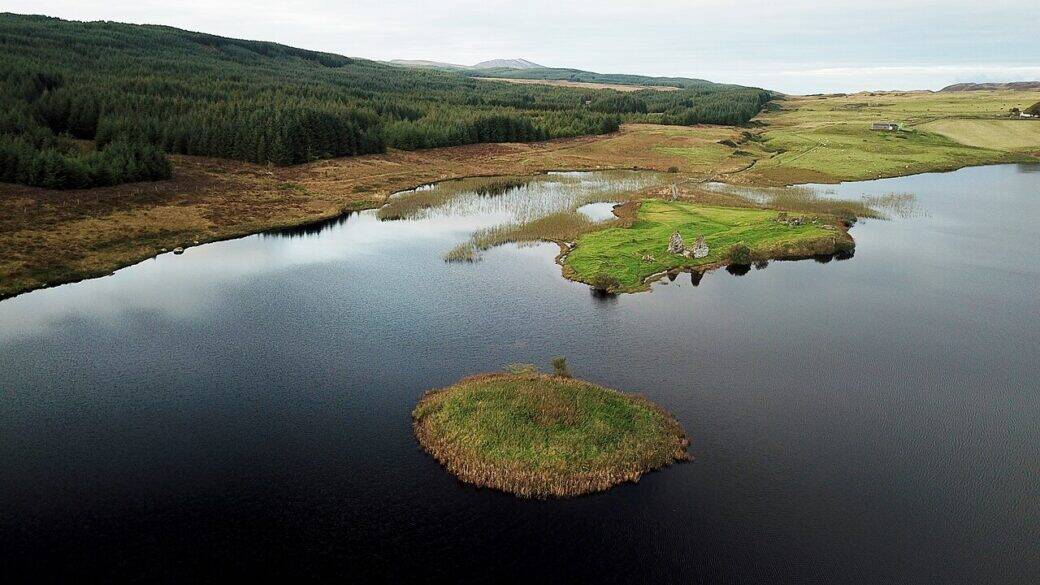
The BBC reports that archaeologists have unearthed evidence of a “forgotten” royal castle at Finlaggan on the Hebridean island of Islay, Scotland, revealing a fortress that once may hve served as home to kings ruling western Scotland over 700 years ago.
The site, built across two small islands in a loch during the 12th and 13th centuries, was later associated with the MacDonald clan chiefs, known as the Lords of the Isles. The old castle included a rectangular stone tower resembling a keep, living quarters, courtyards, kitchens, a great hall for feasting, and a chapel with a burial ground. Such towers were symbols of power and wealth, similar to those built by Anglo-French kings in Britain and Ireland. The structure may have been demolished due to instability or damage from attacks, with a palace later constructed on the site for the Lords of the Isles.
Historical context
Finlaggan served as a power base for the Lords of the Isles, who controlled the Hebrides, Argyll, and parts of the northwest Highlands. These lords acted like kings, considering themselves equals to Scottish and English royalty, and conducted raids on mainland Scotland, including Urquhart Castle on the famous Loch Ness. The site’s history predates the lords’ rise, with remains dating back to the 12th and 13th centuries.
Research efforts
Nearly 30 years of archaeological study, involving specialists and volunteers led by Dr David Caldwell, have culminated in a new book published by the Society of Antiquaries of Scotland. The book uses visualizations and drone images to depict the site, including thatched-roof buildings, a conical tower, and a stone keep connected by a bridge.
Expert insights
Dr David Caldwell, the research team leader, stated: “The processing of all the data that was gathered has been a major part of my life since the 1990s and I hope I have not only provided an account of interest but also a basis for others to carry out more research in the future.” Dr Helen Spencer, head of research at the Society of Antiquaries of Scotland, emphasized the charity’s mission to share knowledge of the past widely.
Significance
This discovery highlights Finlaggan’s role in the kingdom of the Lords of the Isles and provides new insights into medieval Scottish history.
Source: bbc.com