In the rolling countryside of West Sussex, England, lies Knepp Castle: a 3,500-acre estate that has become synonymous with one of the most ambitious and successful rewilding projects in the UK. Once a struggling dairy and arable farm, Knepp has transformed into a thriving mosaic of habitats teeming with wildlife, from nightingales and turtle doves to beavers and white storks. This shift, spearheaded by owners Sir Charles Burrell and Isabella Tree, challenges conventional notions of land management and offers a blueprint for restoring biodiversity in a nature-depleted nation.
The end of traditional farming
The story of Knepp’s rewilding begins with economic hardship and a bold pivot. Inherited by Charlie Burrell in 1983 at the age of 21, the estate had been farmed intensively for generations. However, the heavy Weald clay soil—described as “concrete in summer and porridge in winter”—proved ill-suited to modern agriculture. Despite investments in machinery and efforts to maximize yields, the farm operated at a loss, hemorrhaging money year after year. By 2000, Burrell made the drastic decision to sell off the dairy herds, machinery, and even the milk quota, outsourcing arable operations to contractors. This marked the end of traditional farming at Knepp and the dawn of something revolutionary.
Herbivores shaping the landscape
The catalyst for change came in 2001 when the estate secured Countryside Stewardship funding to restore a 350-acre Repton-designed parkland that had been ploughed during World War II. Seeding the area with native grasses and wildflowers, and introducing fallow deer from nearby Petworth House, Burrell witnessed nature’s rapid resurgence. Inspired by Dutch ecologist Frans Vera‘s book Grazing Ecology and Forest History, which posits that prehistoric landscapes were shaped by large herbivores rather than dense forests, Burrell embraced a “process-led” rewilding approach. This non-goal-oriented strategy focuses on restoring natural dynamics through free-roaming animals, allowing ecosystems to evolve without human intervention.
A biodiverse wilderness
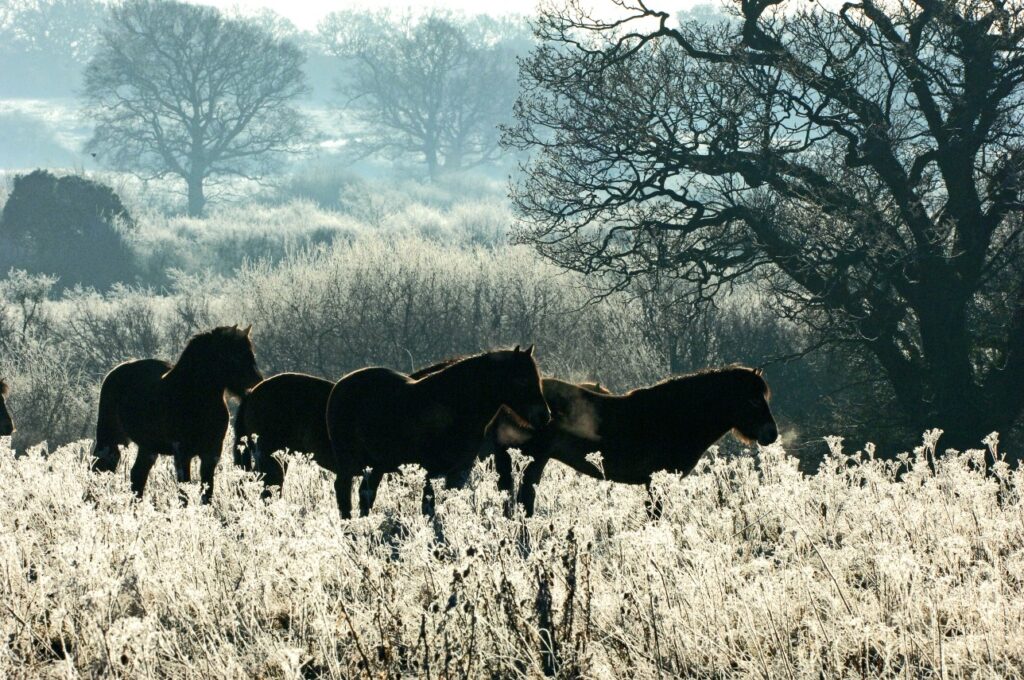
By 2002, Burrell submitted a letter of intent to Natural England, proposing the creation of “A Biodiverse Wilderness Area in the Low Weald of Sussex.” Initial government support was tentative, but funding from the Higher Level Stewardship scheme arrived in 2010, solidifying the project’s foundation. Internal fences were removed across the estate’s three blocks—Southern, Middle, and Northern—creating vast areas for naturalistic grazing. Proxy species for extinct megafauna were introduced: English Longhorn cattle as stand-ins for aurochs, Exmoor ponies for tarpan wild horses, Tamworth pigs for wild boar, and red, roe, and fallow deer. These animals roam freely, browsing, grazing, rooting, and trampling to create diverse habitats like scrub, grassland, and wood pasture.
Spectacular rebound
The principles of rewilding at Knepp are rooted in minimal interference. Unlike traditional conservation, which often targets specific outcomes, Knepp lets ecological processes unfold. Herbivores prevent any single vegetation type from dominating, fostering a patchwork of environments that support a wide array of species. Water management has been key too: ditches were blocked, weirs disabled, and riverbanks eroded to restore the River Adur’s natural meanders, enhancing flood mitigation and water quality. This hands-off ethos has yielded astonishing biodiversity gains, proving that degraded farmland can rebound spectacularly.
Return of biodiversity
Within years, wildlife flourished. Nightingales, whose UK population has plummeted 90% since the 1960s, found refuge in Knepp’s thorny scrub; by 2010, the estate hosted 1% of the national breeding population. Turtle doves, on the brink of extinction in Britain, returned to breed, their purring calls echoing through the undergrowth. Purple emperor butterflies established the UK’s largest colony here by 2015, drawn to the sallow-rich habitats created by browsing animals. Rare insects like the violet dor beetle and barred grass snake thrive, while 13 of the UK’s 18 bat species, including the barbastelle, have been recorded.
Mammals and birds have staged remarkable comebacks. Ravens nested for the first time in centuries in 2009, and peregrine falcons now hunt over the wildlands. In 2018, white storks were reintroduced through a partnership with the White Stork Project; by 2020, chicks fledged in the wild for the first time in England since 1416. Beavers, absent from Sussex for 400 years, were released in 2020, their dams creating wetlands that boost fish populations and purify water. Even vagrant species, like the black stork in 2016 and the emperor dragonfly in 2021, have appeared, underscoring Knepp’s role as a biodiversity hotspot.
Beyond fauna, Knepp’s flora has diversified. Natural regeneration has seen blackthorn, hawthorn, and dog rose proliferate, forming dense thickets that protect young trees from herbivores. Oak saplings emerge in “thorny nurses,” mimicking ancient wood pastures. Soil health has improved dramatically: fungal networks expanded, carbon sequestration increased, and microbial diversity surged, turning once-barren clay into fertile ground. These changes extend ecosystem services—flood control, pollination, and air purification—benefiting the wider landscape.
New business models
Economically, Knepp defies critics who decried rewilding as an “immoral waste of land.” The project generates income through sustainable ventures. Annually, 75 tonnes of organic, pasture-fed meat from culled animals is sold, emphasizing high-welfare, low-impact production. Tourism is a cornerstone: wildlife safaris, glamping, camping, and holiday cottages attract visitors eager for immersive nature experiences. With 16 miles of public footpaths and five viewing platforms, Knepp welcomes walkers while maintaining tranquility for wildlife. Additional revenue streams include venue rentals, educational programs, and wellness activities like yoga retreats. This model has not only made the estate profitable but also stimulated the local economy, supporting nearby businesses.
Pragmatic solutions
Challenges have been inevitable. Early on, neighbors complained about the “untidy” appearance, labeling it an eyesore. Regulatory hurdles delayed funding, and balancing rewilding with public access required careful management—safaris are limited to those aged 12 and up to minimize disturbance. Climate change poses ongoing threats, but Knepp’s resilient ecosystems adapt better than monocultures. Critiques from some ecologists note that true wilderness is unattainable in densely populated Britain, yet Knepp’s hybrid approach—combining rewilding with selective human input—offers pragmatic solutions.
In recent years, Knepp has evolved further. After two decades, Burrell and Tree are integrating regenerative agriculture on 150 acres previously leased for sheep. This “rewilded farming” uses Sussex cattle in a “calf-at-foot” microdairy and market gardens fertilized by cow manure, supplying a new farm shop and cafe. Baseline surveys track soil and insect health, aiming to blend food production with biodiversity. This shift addresses post-Brexit subsidy uncertainties and demonstrates how rewilding principles can enhance farming viability.
Awards
Looking ahead, Knepp’s influence extends beyond its borders. The Weald to Waves initiative seeks to create a county-wide wildlife corridor, linking habitats from the High Weald to the coast. Already, 37 neighboring farmers form a cluster group, adopting nature-friendly practices. Potential reintroductions of wildcats and pine martens could further enrich the ecosystem. Globally, Knepp inspires projects from Europe to Africa, as chronicled in Tree’s book Wilding (2018) and the 2023 film adaptation. Awards abound: the 2015 People Environment Achievement for Nature, the 2017 Anders Wall Award, and ZSL’s Silver Medal in 2023 for Burrell and Tree.
Knepp’s success underscores a profound truth: nature, given space and time, can heal itself. In an era of ecological despair, this Sussex estate offers hope—a living proof that rewilding isn’t just about wildlife; it’s about reimagining our relationship with the land. As Burrell reflects, “It’s a story of hope,” one that invites us all to participate in nature’s revival.
Knepp Castle and the Burrell Family
The original Knepp Castle was a motte-and-bailey structure, likely built in the early 12th century by William de Braose, 1st Lord of Bramber, as a fortified residence near the River Adur. King John seized it in 1208, using it as a hunting lodge and visiting frequently. Amid the First Barons’ War, he ordered its demolition in 1215–1216, though it endured as a royal retreat for Henry III, Edward II, and Richard II. By the 18th century, it had fallen into ruin, its stones repurposed for local roads. Today, only a 11-meter-high wall of Horsham Stone remains, protected as a scheduled monument and Grade II listed building.
Ownership shifted in 1788 when Sir Charles Raymond, enriched by the East India Company, acquired the manor. It passed to the Burrell family through marriage; Sir Merrik Burrell built the current Gothic Revival mansion in 1809–1812, designed by John Nash, near the ruins. The Burrells, with roots in Sussex ironworking and a baronetcy created in 1766, have held the estate for over two centuries. Notable figures include Walter Wyndham Burrell, a 19th-century Freemason leader, and the family’s ties to properties like Ockenden and West Grinstead Park.
The current owners, Sir Charles “Charlie” Burrell, 10th Baronet (born 1962), and his wife Isabella Tree, inherited the estate in the 1980s. Burrell, educated at Millfield and the Royal Agricultural College, farmed intensively before pioneering rewilding. Tree, an acclaimed author and conservationist, has documented their journey in books like Wilding and The Book of Wilding. Together, they lead the Knepp Wildland Foundation, earning accolades for their ecological contributions. Their vision has turned a family legacy into a global model for sustainability.