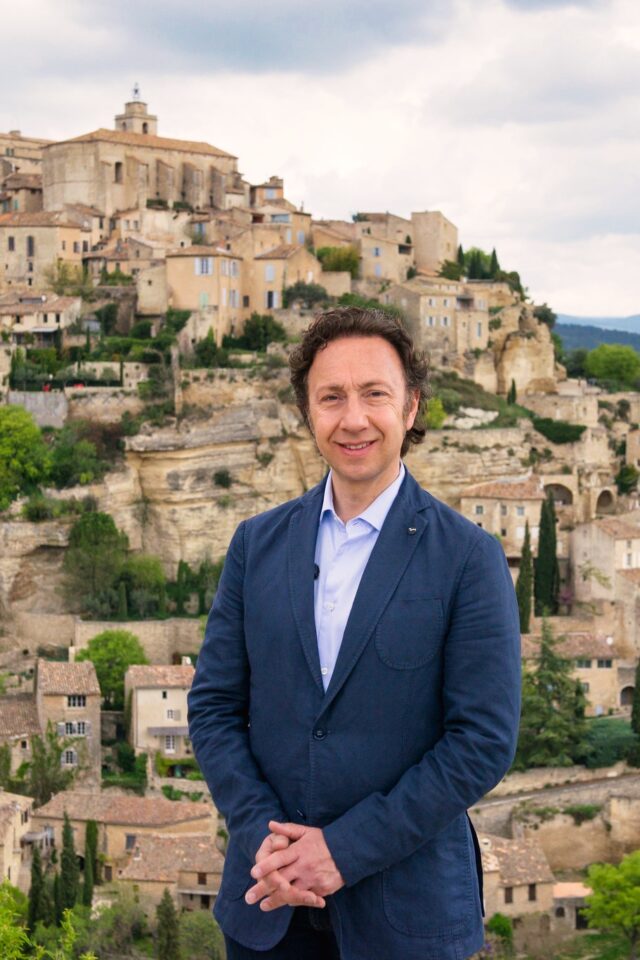
When researching how European countries cherish their castles, gardens and historic houses, one inevitably encounters certain recurring figures. In France there is the ever smiling Monsieur Patrimoine, championing heritage with missionary zeal. Across the Channel, an equally unmistakable presence emerges. Small in stature, sharp in wit, armed with irony, curiosity, and… a hairclip. I am hinting, of course, at Lucy Worsley, Britain’s most personable custodian of the past.
Red lipstick, practical boots
Petite, light-blonde, often dressed with an echo of the past, Lucy Worsley appears on TV always with red lipstick, practical boots and…a hairclip. Her (rather low) voice is unmistakable: precise, slightly playful, lightly clipped, as if she is permanently sharing a private joke with the audience. It is a voice that suggests curiosity rather than authority. And precisely that is her secret weapon.
Wikipedia tells us that she was born in 1973 in Reading, into an academic household. She studied history at Oxford before completing a doctorate. She is married to architect Mark Hines and lives in South London. She was appointed Officer of the Order of the British Empire (OBE) in 2018 and won a BAFTA Award in 2019 for the program Suffragettes with Lucy Worsley. But none of that explains why she feels so at home in a Tudor corridor or Georgian drawing room. She doesn’t merely explain old buildings. She inhabits them.
Wit as a historical tool
What distinguishes Lucy from so many other television historians? Above all, it is her British sense of humour. The dry aside, the raised eyebrow, the tongue-in-cheek, the gently comic emphasis on the absurdities of the past. She once remarked that what people truly want to know about history is not kings and battles, but how they went to the toilet. As someone who gives tours in and around castles, I can confirm this.
In interviews, she has repeatedly stressed that history must be enjoyable to be meaningful. Not dumbed down, but warmed up. History, in her hands, becomes sociable. It invites you in, offers you a cup of tea, and then quietly tells you something profound. This approach mirrors what Stéphane Bern does in France. Both understand that heritage survives not through reverence alone, but through affection.
A life among palaces
Worsley spent more than twenty years as a senior curator at Historic Royal Palaces, overseeing some of Britain’s most significant sites: Hampton Court, Kensington Palace, the Tower of London, Kew Palace. This is not merely a job title—it is a vocation.
Unlike many presenters, Worsley did not arrive at heritage through television. Television arrived because as curator, she already lived and breathed historic buildings like no other. She understands how a palace functions, how a corridor directs power, how a bedroom reveals politics. Her books and programmes consistently return to rooms, objects, and daily routines. History, she shows her viewers, happens indoors.
Style, substance and self-mockery
Lucy Worsley doesn’t present herself as grand. Her instinctive humour keeps grandeur firmly in check. She gently reminds us that history, like people (or life for that matter), is at its best when it does not take itself too seriously. In interviews she downplays her success, credits luck, timing, and circumstance, and gently deflates the idea of celebrity. She would rather be thought clever than important.
Her appearance reinforces this balance. Her refined yet practical style of dressing expresses her persona. The trademark hairclip gives her a disarming, schoolgirl-like look.
Heritage with a human face
What connects Lucy to Monsieur Patrimoine is her insistence that heritage belongs to everyone, not as spectacle, but as shared inheritance. Bern turned heritage into a national conversation in France. Worsley does something similar in Britain, in her own unique style. She brings her audience into the past not by commanding attention, but by inviting curiosity. She does not shout, she nudges. She suggests. She makes you lean in, so to speak.
And crucially, she reminds us that the great castles and gardens we like to visit were once lived in. They were messy, drafty, emotional places. People argued, laughed, fell in love, and worried about money there. In Worsley’s storytelling, history is not embalmed, it breathes.
Lucy’s literary output
Lucy’s work as an author has become an essential extension of her public role. As a Sunday Times bestselling writer, she focuses on social and cultural history, often favouring domestic life and lived experience over grand political narrative. Books such as If Walls Could Talk and A Very British Murder have been praised for their clarity, narrative energy and careful research. Critics frequently highlight her ability to make complex material accessible without sacrificing nuance, while some academic reservations about her popular style are countered by the breadth and loyalty of her readership.
Lady Killers and a modern way of telling history
With the BBC series Lady Killers, Worsley has brought her historical curiosity into new formats, combining podcast, newsletter, and public debate. The series revisits crimes committed by women in the nineteenth and early twentieth centuries, examining how they were judged in their own time and how they continue to echo today. Working with female historians and experts, Worsley explores themes of gender, power and social constraint, balancing serious analysis with her accessible, conversational tone. The result is history that feels immediate, reflective and sharply relevant. Even here, far from palace corridors, Worsley remains attentive to setting and context, reminding us that history, whether criminal or domestic, always unfolds somewhere.
Lucy’s legacy
Lucy Worsley’s enduring contribution lies not only in what she knows, but in how she chooses to share it. By presenting heritage as something lived rather than revered from a distance, she lowers the threshold without lowering the standards. Castles, palaces and historic houses become places of curiosity rather than intimidation, their stories shaped by people as much as by power. In an age when preservation depends increasingly on public affection, Worsley’s work offers a persuasive model: heritage sustained not by grandeur alone, but by wit, warmth and the simple pleasure of being invited in.
Find out more about Lucy at her personal website: www.lucyworsley.com
Heritage Heroes
Across Europe, historic houses, castles, and gardens survive not only through conservation policies and restoration budgets, but through people—individuals who translate heritage into lived experience. They act as interpreters between past and present, experts and audiences, stone and story. Some are historians, others curators, gardeners, or broadcasters. What unites them through time and space is their love for art, craftmanship en their ability to make heritage feel relevant, accessible, and emotionally resonant.
This series explores such ambassadors of European heritage: figures who have shaped public affection for historic places by the way they speak about them, move through them, and invite others inside. From palace corridors to walled gardens, from grand estates to working landscapes, these individuals remind us that heritage is not only something to be preserved, but something to be understood, used, and cared for.