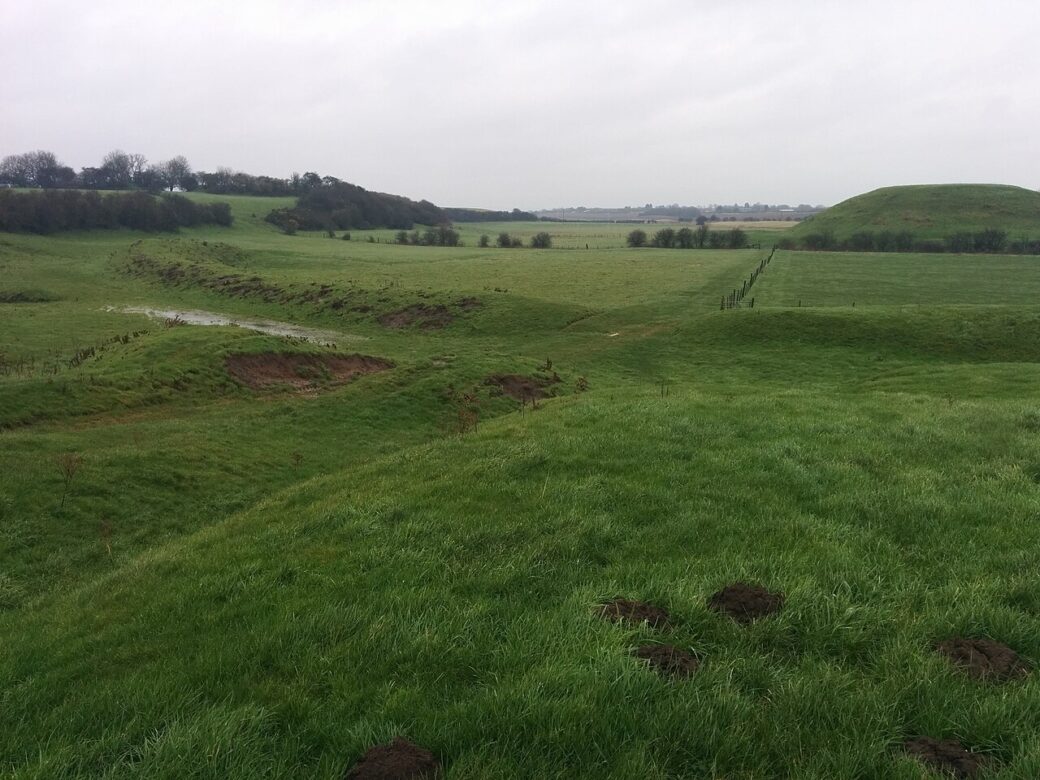
SKIPSEA, ENGLAND – Archaeologists believe they may have uncovered one of the most significant Anglo-Saxon sites found in decades: a high-status settlement that could be connected to Harold Godwinson, the last Anglo-Saxon king of England. If confirmed, the discovery would offer a glimpse into elite life on the eve of the Norman Conquest. The findings centre on a site near Skipsea, a location already known for its Norman motte-and-bailey castle but whose earlier history had remained largely unexplored.
A hall fit for a king?
Excavations have revealed the remains of a large timber hall, along with associated buildings and features that point unmistakably to wealth and power. Archaeologists identified substantial postholes and a cellar, suggesting a structure far larger than an ordinary farmhouse. Such halls were the political, economic, and social centres of Anglo-Saxon lordship — places where feasts were held, justice was administered, and loyalty was forged.
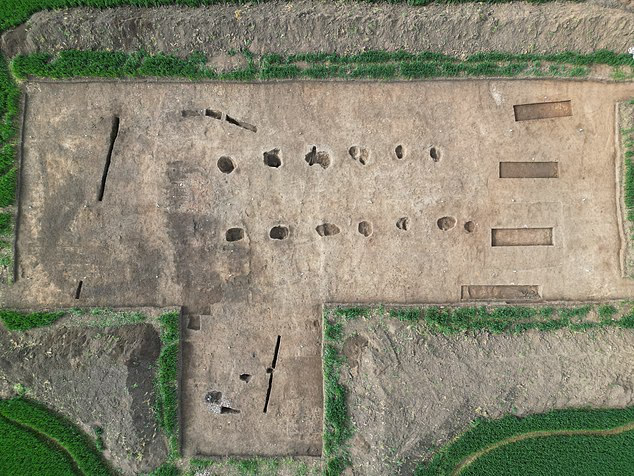
Particularly striking is evidence for a malthouse, used to germinate barley for brewing ale. Beer was central to Anglo-Saxon culture, but dedicated malthouses are rare finds, usually associated with elite estates. Charred grains recovered from the site appear to confirm the brewing process was taking place here, reinforcing the impression of a well-resourced, high-status complex.
Among the smaller finds was a piece of worked amber, likely part of jewellery. Amber was a valuable material, often traded over long distances, and its presence further underlines the site’s elite character.
Harold Godwinson and the north

The potential link to Harold Godwinson is grounded in both archaeology and history. Harold, who became king Harold II in 1066, was already one of the most powerful men in England long before his coronation. As Earl of Wessex and a leading member of the Godwin family, he held extensive lands across the country — including estates in Yorkshire recorded in later sources such as the Domesday Book.
Skipsea itself later became a Norman stronghold, but the newly discovered Anglo-Saxon complex lies just outside the Norman castle footprint. This pattern — Normans building castles beside, rather than directly on top of, existing elite Anglo-Saxon centres — is well known elsewhere in England. It raises the intriguing possibility that the Norman castle deliberately replaced an earlier seat of power.
While archaeologists stress that there is no definitive proof that Harold himself lived at the site, the scale, date, and status of the settlement make a connection to the highest levels of Anglo-Saxon society entirely plausible.
Life on the eve of 1066
What makes the discovery especially compelling is its timing. The site appears to have been active in the decades immediately before the Norman Conquest, a period of political tension, shifting alliances, and looming conflict. Material evidence from this era is often elusive, particularly when it relates to the lives of the ruling elite.
Finds like this help move history beyond chronicles and battle narratives. They allow us to imagine the practical realities of power in late Anglo-Saxon England: the halls where decisions were made, the food and drink consumed during feasts, and the economic networks that sustained noble households.
As Jim Leary, one of the archaeologists involved, noted in The Times, the combination of buildings and artefacts makes this an “exceptional” site, one that could reshape understanding of the region’s importance before 1066.
What comes next?
The excavation is part of a long-term research project, and further seasons of digging are planned. Future work may reveal additional buildings, richer artefacts, or dating evidence that could strengthen (or complicate) the case for a direct connection to Harold Godwinson.
Even without definitive royal attribution, the site already stands as one of the most important Anglo-Saxon discoveries in northern England in recent years. It highlights how much of the pre-Conquest landscape still lies hidden beneath fields and how archaeology continues to challenge and enrich written history.
If the hall at Skipsea does turn out to be linked to England’s last Anglo-Saxon king, it would represent not just a remarkable archaeological find, but a poignant reminder of a world that ended abruptly in 1066 — and of the people who lived, ruled, and feasted just before history changed forever.
Source: The Times