In the heart of Campania, north of Naples, stands the largest royal palace in the world by volume. This building, known locally as the Reggia di Caserta, is a monument to the Bourbon dynasty that once ruled the Kingdom of Naples. To stand before it is to feel the weight of history pressing down. This is no mere palace; it is a declaration, a challenge to the gods of beauty and power, and it calls to those who are eager to walk its halls and lose themselves in its magnificence.
Birth of a Titan
In 1752, on 20th of January, the first stone of the palace was laid by Charles of Bourbon (1716–1788), then King of Naples. The sovereign dreamed of a grand palace to rival the French Palais de Versailles, the masterpiece of his great-great-grandfather, Louis XIV. He envisioned a fortress of power, not far from Naples. Caserta, a quiet plain nestled among hills, seemed his ideal refuge and a canvas for his grand ambitions.
Luigi Vanvitelli (1700–1773), also known as Lodewijk van Wittel, a Neapolitan with Dutch roots, was the chosen architect. His vision matched the king’s hunger for grandeur. He designed a palace so vast it seemed to stretch beyond the horizon: 1,200 rooms, 1,742 windows, and five floors. This labyrinth of marble, stucco and frescoes could house not just the royal court, but an entire kingdom! The architectural style of the day was, of course, Baroque, but Vanvitelli’s design leaned toward the future, forming a bridge to Neoclassicism, a style that would soon echo across Europe.
Not one night
Fun fact: King Charles VII never spent a single night in his magnificent palace. In 1759, he abdicated to become King Carlos III of Spain, leaving the unfinished dream to his son, Ferdinand IV. Vanvitelli died in 1773, and his son Carlo took up the mantle, guiding the palace to its final completion nearly a century after the first stone was laid, in 1845. The Reggia was a labor of generations, built by slaves, convicts, and local craftsmen—their sweat mingling with the mortar. It was a monument to power, but also to human endurance.
“Fun fact: King Charles VII never spent a single night in his palace. In 1759, he abdicated to become King Carlos III of Spain – “
As so many castles and palaces, this was more than a home; it was a statement. Its four wings enclosed four courtyards, a city within a city, where nobles, administrators, and soldiers moved like pieces on a chessboard. The grand staircase, a marvel of marble and light, led to the royal apartments, where frescoes told stories of gods and kings. The Throne Room, gilded and vast, was the heart of the palace, a space where decisions shaped nations.
Vanvitelli’s Hand: The architect’s lasting mark
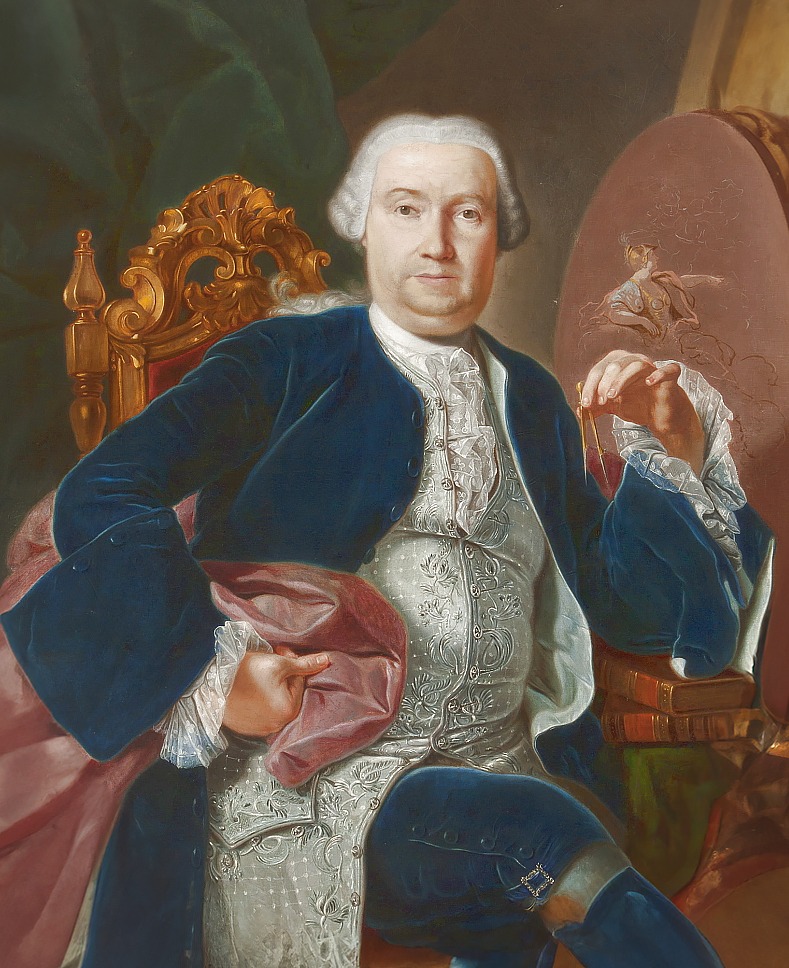
Luigi Vanvitelli was no ordinary architect; he was a sculptor of space, a master of proportion, and a visionary who reshaped the very idea of what a palace could be. Born in Naples in 1700 as the son of an Italian woman and a Dutch painter of land and cityscapes, Caspar van Wittel, who also used the name Vanvitelli. Luigi carried in his veins a fusion of Northern precision and Southern passion. He studied under the great architects of Rome, absorbing the lessons of Bernini and Borromini, but his work at Caserta would surpass them all, a testament to his ability to balance grandeur with restraint.
Vanvitelli’s influence on the Reggia is felt in every line, every curve, every shadow. He conceived the palace as a single, unified organism, a structure where form and function danced in harmony. The façade, stretching 245 meters, is a study in symmetry, its rows of windows and pilasters creating a rhythm that feels almost musical. Yet it is not ostentatious; Vanvitelli rejected the florid excesses of late Baroque, choosing instead a cleaner, more monumental style that anticipated the neoclassical era.
Grand Staircase
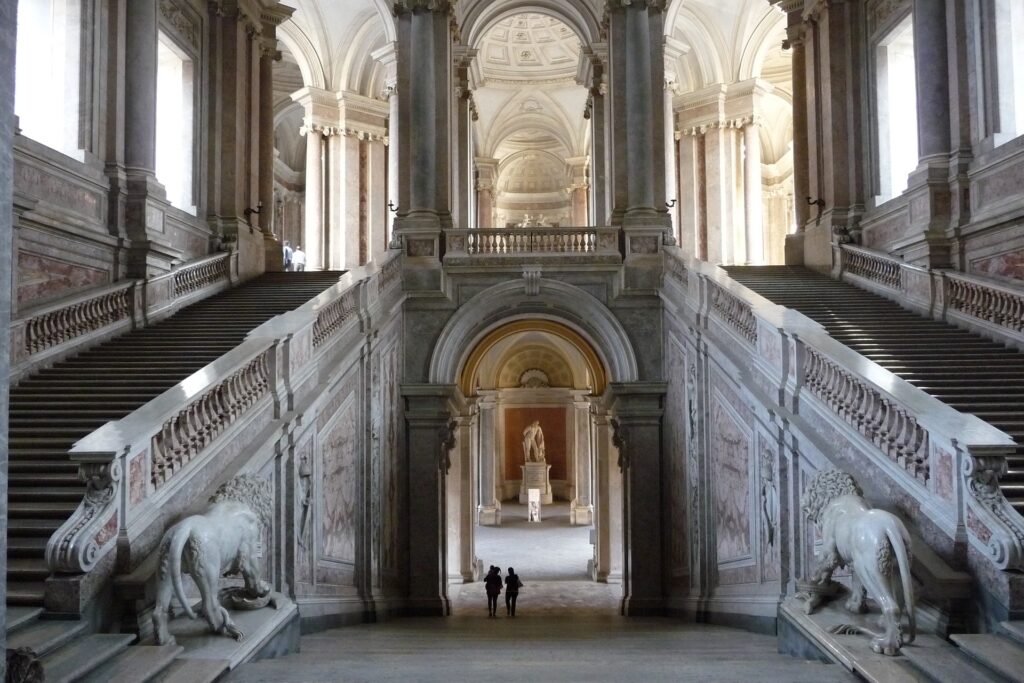
The grand staircase, a masterpiece within the masterpiece, is a triumph of engineering and aesthetics. Its 116 steps, carved from Sicilian marble, ascend in a single, unbroken sweep, flanked by twin ramps that seem to defy gravity. The vault above, adorned with frescoes by Antonio de Dominicis, creates an illusion of infinite height, a space that feels both intimate and celestial. This staircase was not just a passage; it was a stage, a place where kings and courtiers could be seen and admired, a symbol of Vanvitelli’s understanding of power as performance.
The Gardens
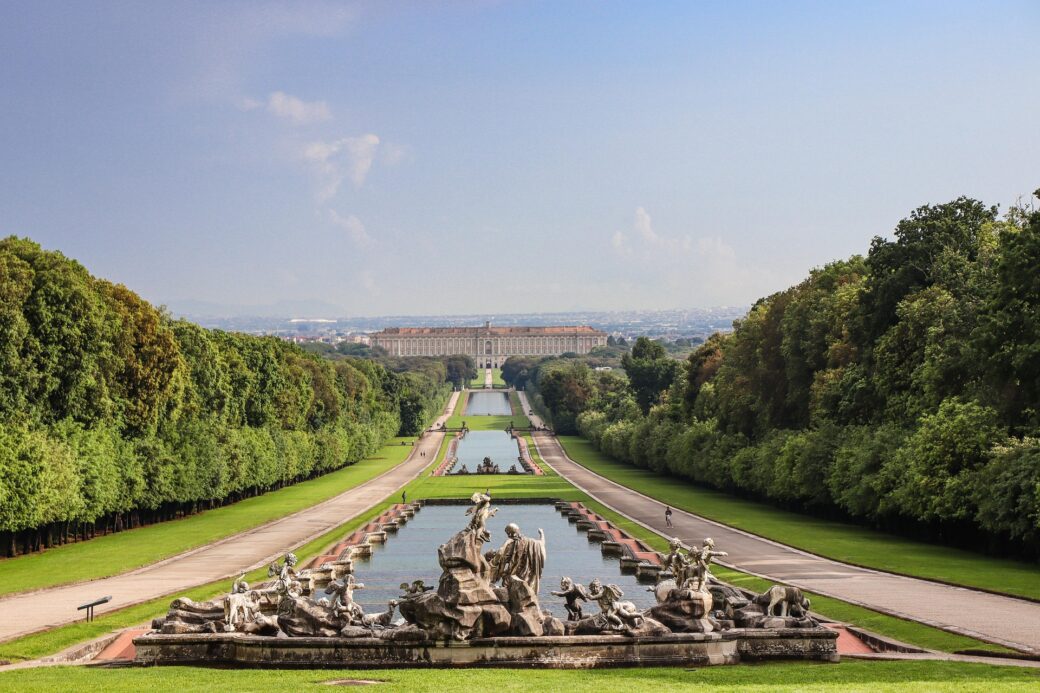
To match the grandeur of the palace, Vanvitelli conceived an equally majestic design for the Royal Gardens. He constructed a landscape of cascading fountains, vast basins, and a canal that stretches endlessly toward the horizon. Drawing inspiration from Roman engineering, Vanvitelli constructed a 38-kilometer aqueduct to supply water not only to the waterworks and gardens, but also to the surrounding region. The Caroline Aqueduct still stands today, a monument in its own right, its arches striding across the Campanian plain. This was Vanvitelli’s way of ensuring that the Reggia would be more than a palace—it would be a living, breathing entity, sustained by the lifeblood of fresh water.
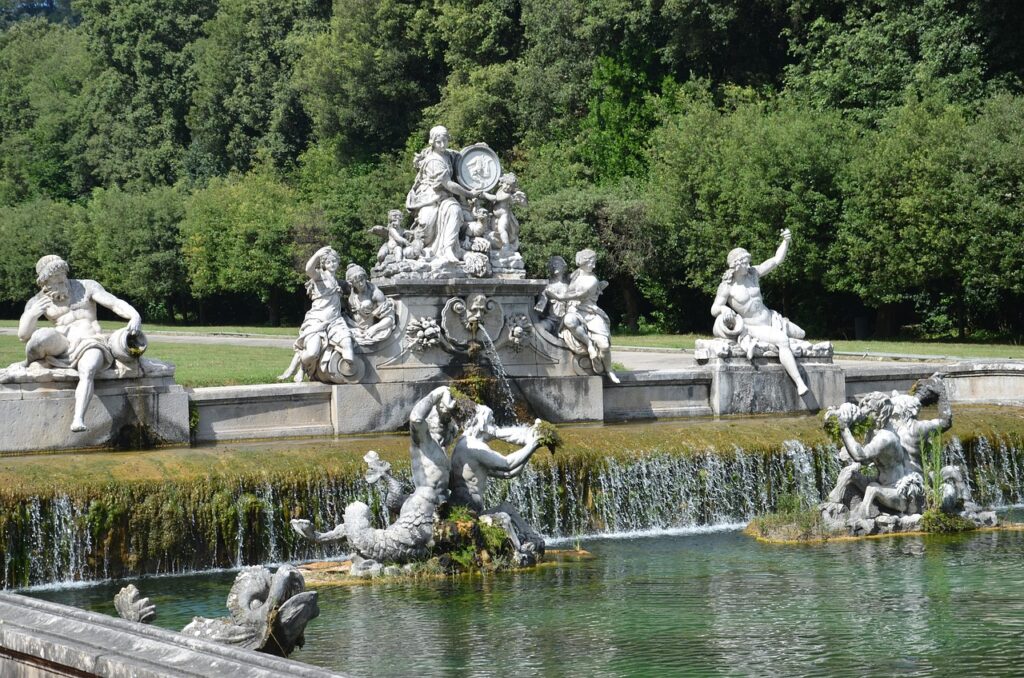
Vanvitelli designed the Royal Park as an extension of the palace itself, with an orchestrated sequence of fountains and pools creating a “telescope effect,” leading the eye toward the distant waterfall. This was no mere embellishment; it was a philosophical statement—an expression of Enlightenment ideals that celebrated order, harmony, and the interplay between nature and human ingenuity. The gardens were not so much about domination but about balance, a sort of dialogue between the wild and the refined—a concept that his English contemporary Capability Brown (1716–1783) would refine and popularize in his naturalistic landscapes.
After Luigi’s death in 1773, his son Carlo Vanvittelli (1739 – 1821) oversaw the palace’s completion. Carlo remained faithful to his father’s vision, ensuring the Reggia’s legacy would stand unaltered. Across Europe, architects studied Vanvitelli’s work, shaping the evolution of neoclassicism and inspiring figures like Étienne-Louis Boullée and Karl Friedrich Schinkel. Just like Versailles, the Reggia di Caserta became a benchmark, a model for royal residences from St. Petersburg to Madrid and a testament to Vanvitelli’s genius and the enduring power of his designs.
Why Reggia di Caserta is worth a visit
Today, the Reggia di Caserta is a UNESCO World Heritage Site, declared in 1997 for its architectural and natural splendor. The museum is a a cultural hub, and a place of pilgrimage for those who seek beauty. It is worth a visit because it is a challenge to the senses, a place where scale and beauty collide. Caserta is not just a palace; it is a monument to human ambition and the eternal quest for greatness.
This palace is special because it is singular, the largest royal palace by volume, a fusion of Versailles and El Escorial, yet uniquely Italian.
For more information about exhibitions, activities, tickets etc., please visit: