Schönbrunn Palace in Vienna is undoubtedly the most famous of all the palaces of the former Habsburg Empire. It has captivated visitors for centuries, offering a glimpse into the lives of one of Europe’s once most powerful dynasties. If you want to immerse yourself in Europe’s imperial past, a visit to Schönbrunn is essential. This irresistible place takes you to a journey through time.
The ‘schöner Brunnen’
As with so many European castles and palaces, the story of Schönbrunn begins in the 14th century, long before its golden facades dominated the Viennese skyline. The estate, originally known as Katterburg, was part of the holdings of the Klosterneuburg Monastery and served as a modest manor with vineyards and meadows. In 1569, Holy Roman Emperor Maximilian II (1527–1576) acquired the property, transforming it into a recreational ground complete with fishponds, aviaries for exotic birds, and a small hunting lodge. This marked the Habsburgs’ first foray into what would become their beloved summer retreat, much like how Louis XIV (1638–1715) later expanded a simple hunting lodge at Versailles into a symbol of absolute monarchy. Legend has it that Emperor Matthias (1557–1619), while hunting in 1612, discovered a schöner Brunnen (beautiful spring) which lent the estate its enduring name.
The early 17th century brought further developments. In 1638–1643, during the reign of Emperor Ferdinand II (1578–1637), a modest pleasure palace was constructed for his wife, Eleonora Gonzaga (1598–1655), who used it as her widow’s residence after his death. This château de plaisance featured Italianate gardens, reflecting Renaissance influences popular at the time. However, the estate’s fortunes waned during the Thirty Years’ War and the second Turkish siege of Vienna in 1683, when Ottoman forces ravaged the grounds, destroying much of the existing structures.

Rebuilding began under Emperor Leopold I (1640–1705), who envisioned Schönbrunn as a symbol of Habsburg resilience, aspiring to rival the emerging splendor of Versailles under French absolutism. In 1687, he commissioned the renowned architect Johann Bernhard Fischer von Erlach (1656–1723) to design a grand hunting lodge for his son, Crown Prince Joseph I (1678–1711). Fischer von Erlach, fresh from studies in Rome, drew explicit inspiration from Versailles, proposing an extravagant palace atop the hill now occupied by the Gloriette. Though financial constraints scaled back the plans—unlike the boundless resources poured into Versailles—construction started in 1695, resulting in a more modest but elegant Baroque residence by 1700. The palace featured a central corps de logis with wings, adorned in the iconic “Schönbrunn Yellow”—a hue derived from ochre pigments, symbolizing imperial prestige and later becoming synonymous with Habsburg architecture, much as the golden tones of Versailles evoked solar kingship.
Tragedy struck when Joseph I died of smallpox in 1711, leaving the palace incomplete. His successor, Charles VI (1685–1740), showed little interest, using it sporadically for hunting. It wasn’t until his daughter, Maria Theresa (1717–1780), inherited the throne in 1740 that Schönbrunn’s true transformation began.
Golden age: Maria Theresa’s Baroque masterpiece
Maria Theresa (1717–1780), the only female ruler of the Habsburg dominions, elevated Schönbrunn to its pinnacle of splendor, creating a courtly environment that subtly mirrored the ceremonial pomp of Versailles while emphasizing familial warmth. Ascending amid the War of the Austrian Succession, she sought to assert her authority through architectural grandeur. From 1743 onward, she and her husband, Francis I (1708–1765), Holy Roman Emperor from 1745, redesigned the palace and gardens as a summer residence, making it the epicenter of court life.
Under the direction of architect Nikolaus Pacassi (1716–1790), the palace was expanded between 1744 and 1749, incorporating Rococo elements into the Baroque framework—a stylistic blend that paralleled the evolving tastes at Versailles during the reign of Louis XV (1710–1774). The facade was unified with the signature yellow plaster and white accents, while the interior boasted 1,441 rooms, including opulent state apartments. Maria Theresa’s personal touch is evident in spaces like the Millionenzimmer, paneled with exotic rosewood and adorned with Indo-Persian miniatures, and the Great Gallery, a 40-meter-long hall used for banquets and balls, illuminated by crystal chandeliers—reminiscent of Versailles’ Hall of Mirrors in function, if not in sheer scale.
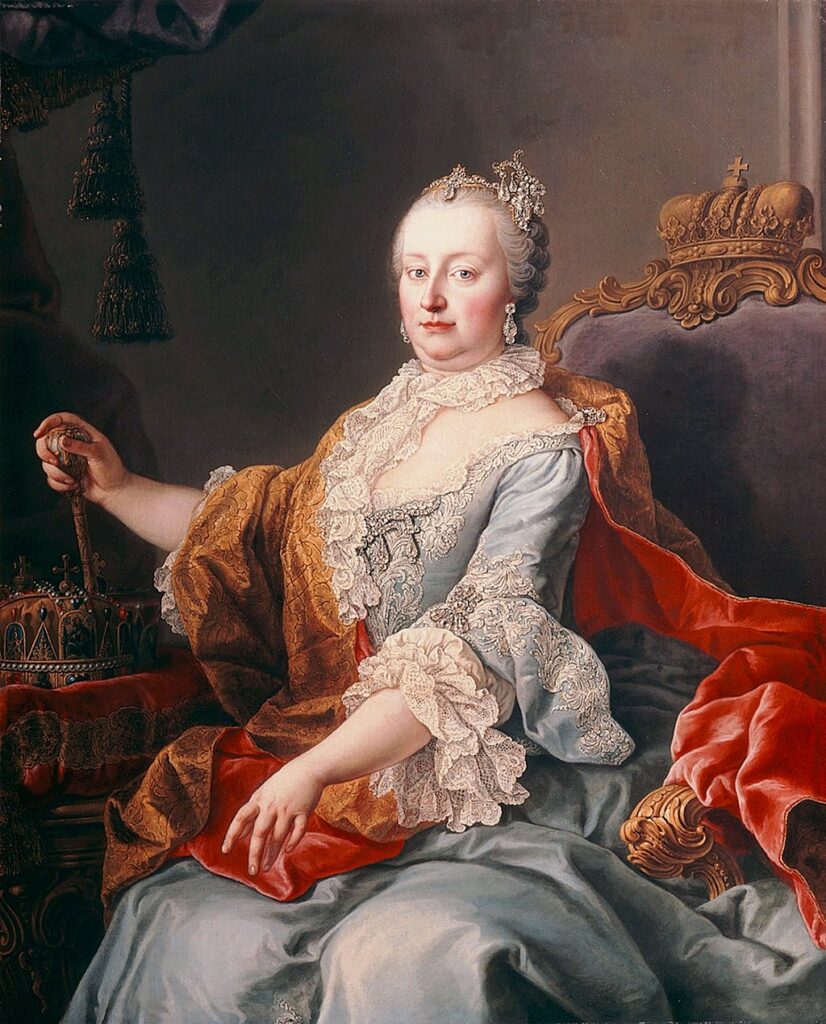
Schönbrunn became a hub of political and cultural activity. It hosted lavish events, including the 1762 performance by a young Wolfgang Amadeus Mozart (1756–1791), who at age six played for the empress and her family in the Mirrors Room. Maria Theresa’s 16 children, including future emperors Joseph II (1741–1790) and Leopold II (1747–1792), and Marie Antoinette (1755–1793), who married Louis XVI (1754–1793) of France, grew up here. The palace witnessed key diplomatic moments, such as negotiations during the Seven Years’ War.
Following Maria Theresa’s death in 1780, her son Joseph II used Schönbrunn intermittently, preferring a more enlightened, restrained approach. His successor, Francis II (1768–1835), later Holy Roman Emperor and Austrian Emperor Francis I, revived its imperial role in the early 19th century, especially during the Napoleonic Wars. In 1805 and 1809, Napoleon (1769–1821) occupied the palace, using it as his headquarters and even residing in Maria Theresa’s former apartments—a twist of fate that saw Schönbrunn briefly serve a conqueror, much as Versailles would later house foreign powers. His son, Napoleon II (1811–1832), the King of Rome, was raised here briefly after 1815.
The 19th century saw further refinements under Emperor Franz Joseph I (1830–1916), who was born at Schönbrunn and spent much of his life there. He modernized the palace with running water and electricity, while his wife, Empress Elisabeth (1837–1898), known as “Sisi,” added personal touches like a private gymnasium. Franz Joseph died in his study in 1916, amid World War I, marking the end of Habsburg rule at Schönbrunn.
Enchanting gardens: A Baroque paradise
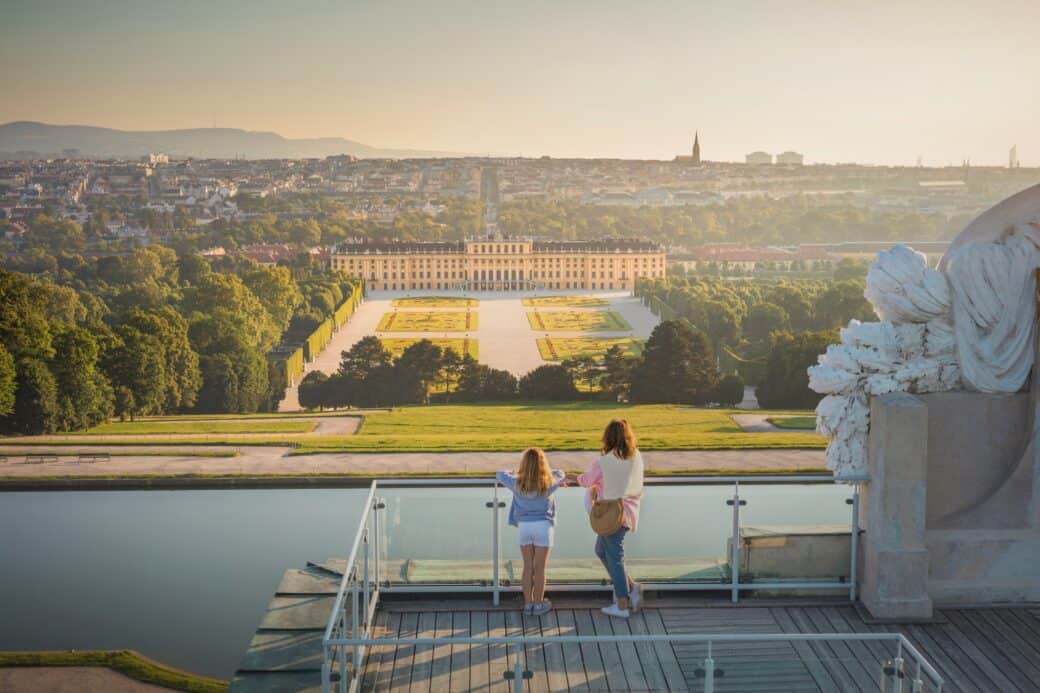
No visit to Schönbrunn is complete without exploring its vast gardens, a 500-acre expanse that mirrors the palace’s historical evolution. Designed as an extension of the imperial residence, the gardens embody the Baroque ideal of taming nature to reflect human order and power, much like the expansive grounds at Versailles that symbolized royal dominion over the landscape.
The gardens’ foundations were laid in the late 17th century under Fischer von Erlach, who envisioned a formal French-style layout inspired by Versailles. Jean Trehet (1654-1740), a pupil of André Le Nôtre (1613–1700), was hired in 1695 to create parterres with intricate flower beds, fountains, and allées. However, the full realization came during Maria Theresa’s reign. From 1753, architect Johann Ferdinand Hetzendorf von Hohenberg (1732–1816) and the Dutch gardener Adrian van Steckhoven (±1705-1782) expanded the park, incorporating mythological sculptures, bosquets (wooded groves), and the iconic Great Parterre: a vast gravel expanse flanked by 32 statues of deities and virtues, evoking the geometric precision of Versailles’ parterres but on a more intimate scale.
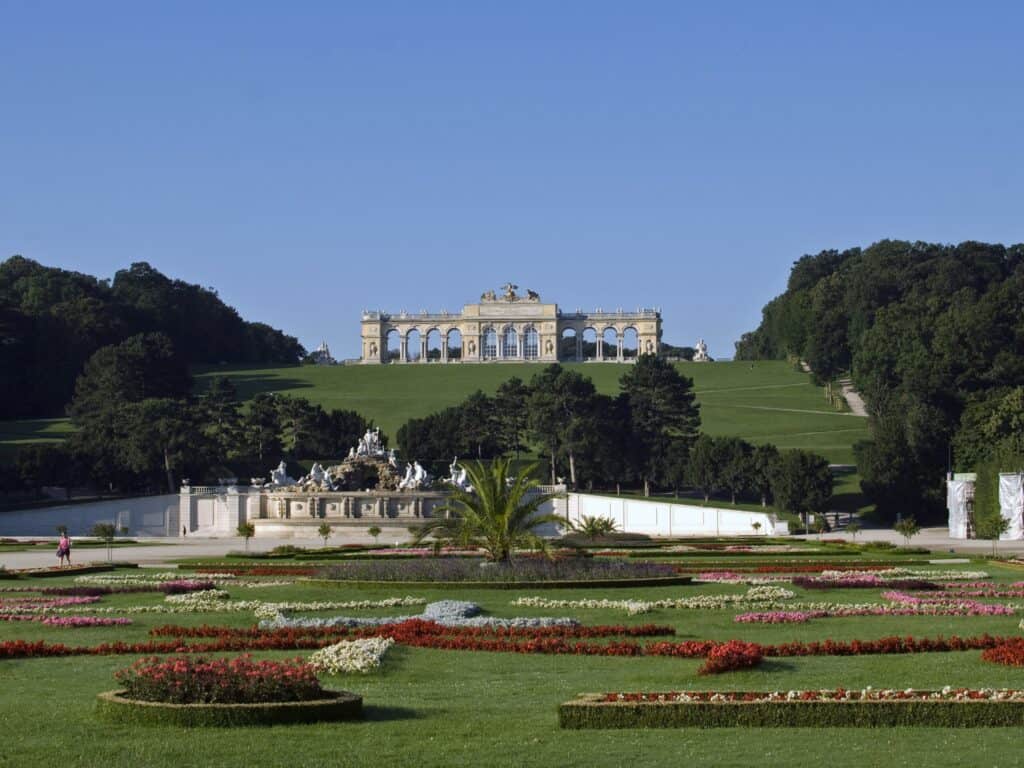
Crowning the hill is the Gloriette, a neoclassical triumphal arch built in 1775 to commemorate Habsburg victories. Originally planned as the palace’s centerpiece, it now offers panoramic views of Vienna, serving a similar vantage point role as the elevated perspectives in Versailles’ design. Below, the Neptune Fountain (1780) depicts the sea god commanding the waters, symbolizing imperial dominion. Other highlights include the Roman Ruin (1778), a faux ancient folly with crumbling columns and statues, and the Obelisk Fountain (1777), adorned with hieroglyphs narrating Habsburg history.
Maria Theresa opened the gardens to the public around 1779, a progressive move that made Schönbrunn a beloved recreational space for Viennese citizens—predating similar public access at Versailles by decades. In the 19th century, additions like the Palm House (1882)—one of the world’s largest greenhouses, housing exotic plants—and the Desert House enriched the botanical offerings. The Tiergarten Schönbrunn, founded in 1752 as a menagerie for Francis I’s exotic animals, evolved into the world’s oldest continuously operating zoo, now home to over 700 species, including giant pandas.
The gardens’ design promotes symmetry and perspective, with long sightlines drawing the eye from the palace to the Gloriette. They have survived wars and occupations, including damage during World War II, and were restored postwar to their Baroque glory. Today, they host events like summer concerts, blending history with contemporary culture.
Schönbrunn in the 20th century and beyond
With the fall of the Austro-Hungarian Empire after World War I in 1918, Schönbrunn passed to the Republic of Austria. It served various roles, including as a hospital during World War I and Allied headquarters post-World War II. In the 1950s, restoration efforts began, and by the 1960s, the palace opened to the public as a museum, attracting millions annually—much like Versailles, which transitioned from royal residence to national treasure.
UNESCO recognition in 1996 affirmed its status as a “unique Baroque ensemble,” encompassing the palace, gardens, and surrounding park. Managed by a state-owned company since 1992, Schönbrunn operates without subsidies, funding preservation through tourism. Recent initiatives include digital virtual tours and sustainable practices, ensuring its legacy for future generations.
Planning your visit
For those inspired to explore, Schönbrunn is easily accessible via Vienna’s U4 metro line (Schönbrunn stop). Tickets range from the Imperial Tour (22 rooms) to the Grand Tour (40 rooms), with audio guides in multiple languages. Don’t miss the gardens—free to enter, they’re perfect for picnics or jogs, with maps available online. Visit in spring for blooming parterres or summer for evening concerts in the Orangery. Allocate a full day to wander the zoo, maze, and hilltop cafe at the Gloriette. With over 4 million visitors yearly, book ahead to avoid queues, and consider a Vienna Pass for bundled attractions.
Schönbrunn Palace and its gardens aren’t merely historical sites; they’re portals to an era of imperial elegance, offering a Habsburg counterpoint to the Sun King’s vision at Versailles. As you stroll the allées or gaze upon the rococo interiors, you’ll feel the echoes of rulers who shaped Europe. In a fast-paced world, Schönbrunn offers a timeless escape, inviting travelers to rediscover the art of grandeur.
More info: www.schoenbrunn.at