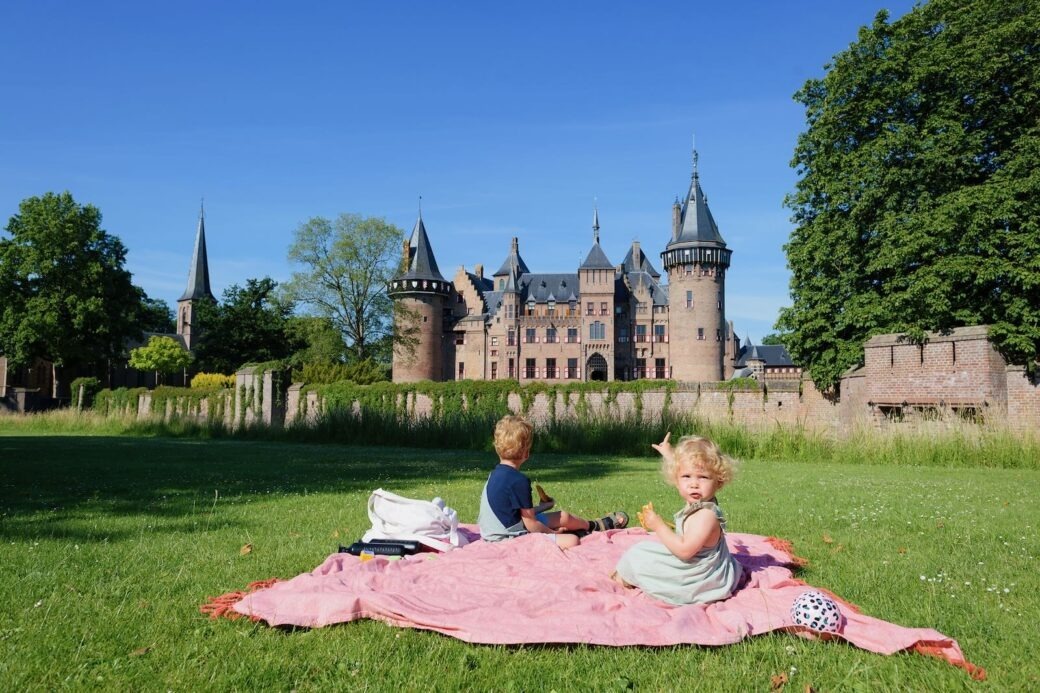
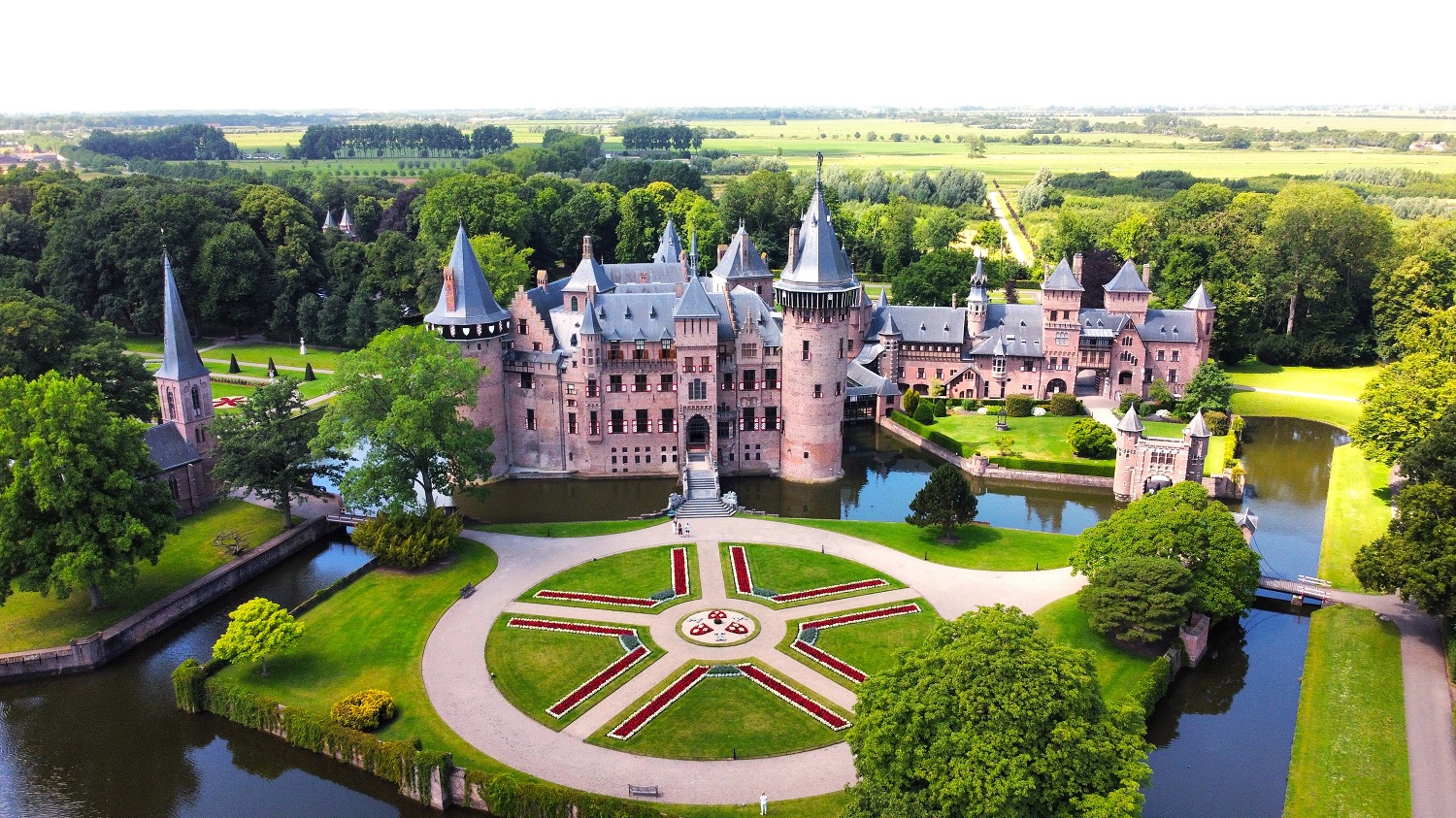
Ask a child to draw a castle, and you’ll get something resembling Kasteel de Haar: turrets, thick brick walls, and red-and-white painted shutters. This is the image from the Grimm fairy tales, later firmly embedded in the collective memory by Disney. In the 19th century, architect Pierre Cuypers was the go-to man to transform the castle ruin that was De Haar into a castle that was both comfortable and fairy-tale-like.
Romantic ruin
For centuries, Kasteel De Haar was merely an old ruin, a dilapidated remnant from a long-gone era when knights fought for the favor of fair maidens. At least, that was the romanticized image of the Middle Ages cherished in the 19th century. It was also during this period that industrialization hit hard, causing many to yearn for the “good old days.”
This was undoubtedly true for Baron Étienne van Zuylen van Nijevelt, who inherited the old ruin in 1890 through an inheritance. He lacked the funds to rebuild the castle himself, but like many noblemen, he married a fabulously wealthy woman from the nouveau riche. His bride, Hélène, a free-spirited (read: lesbian) member of the ennobled Rothschild banking family, enabled him to realize his dream. With Hélène’s millions, the baron commissioned the renowned architect Pierre Cuypers from Roermond to transform the ruin into a castle that was both romantic and comfortable, impressing his guests from the Parisian beau monde.
But before we dive into the 20th-century reconstruction of the castle, let’s go back to the end of the Middle Ages, to the time of the ‘Hoekse en Kabeljauwse twisten‘, the Hook and Cod Wars…
Dirk van Zuylen
At the end of the 15th century, a member of the Van Zuylen family made a name for himself. The family originally lived at Slot Zuylen, among other places, but that castle was no longer in their possession by then. Still, the family enjoyed considerable prestige. Dirk van Zuylen was the mayor of Utrecht at the time and a feudal lord of Kasteel de Haar. This was during the Hook and Cod Wars, and Dirk sided with the Hooks. His Cod rival, Egbert van Wassenaar, made a failed attempt to seize the castle and was captured. However, Stadholder Joost van Lalaing didn’t let it rest; he freed Egbert, and the castle was razed to the ground.
Apparently, all was quickly forgiven, as Dirk’s son, Steven van Zuylen, received the castle as a fief and rebuilt it. In 1536, it was recognized as a knightly manor by the States of Utrecht. After his descendant Johan van Zuylen died childless in 1641, another period of decline followed. The storm of 1674, which also destroyed the nave of Utrecht’s Dom Cathedral, damaged the castle so severely that it was reduced to rubble.
Baron Étienne
Fast forward to 1890. Baron Étienne van Zuylen van Nijevelt, a distant descendant of Dirk van Zuylen, inherits the castle ruin De Haar. Caught up in the fashion of his time, he dreams of rebuilding the old castle. In 1887, the baron marries the immensely wealthy French baroness Hélène de Rothschild. He meets his future wife at a masked ball in Paris, where, dressed as Hercules, he makes an unforgettable impression on her. Despite opposition from both families, this meeting seals the fate of De Haar. The baron’s dream can now be realized: rebuilding the family castle as a tribute to his illustrious ancestors.

Architect Pierre J.H. Cuypers
The transformation of Kasteel de Haar was a perfect project for architect Pierre J.H. Cuypers. This Limburg-born designer had made a name for himself with his elaborately decorated, historicist buildings, such as the Rijksmuseum and Amsterdam Central Station. He also designed numerous Catholic churches and monasteries in his signature neo-Gothic style and restored historical buildings, often letting his imagination run free without being constrained by historical accuracy.
Cuypers’ Fairy-Tale Castle
Thanks to Hélène’s fortune, money was no object in the reconstruction of Kasteel de Haar. To create the surrounding estate, an entire village (now Haarzuilens) was relocated, and around 7,000 mature trees were transported from the Utrechtse Heuvelrug to instantly provide privacy for the castle’s park. Landscape architect Hendrik Copijn collaborated with his friend Cuypers on this project.
Neo-Gothic in white marble
The castle itself was imaginatively rebuilt within its original footprint, adorned with whimsical turrets, spires, galleries, outbuildings, and rich “medieval” decorations. All modern steel and concrete constructions, as well as the then-modern electrical installations, were carefully concealed to give visitors the impression of an authentic medieval castle. Cuypers and his son Joseph worked on the project for twenty years, from 1892 to 1912.
Kasteel de Haar in the 20th Century
In the 20th century, Kasteel de Haar was primarily used in late summer to entertain guests. Many celebrities and film stars enjoyed the luxury of the fairy-tale castle as guests of the baron. Notable names include Brigitte Bardot, Yves Saint Laurent, Coco Chanel, Maria Callas, Roger Moore, Joan Collins, and many others.
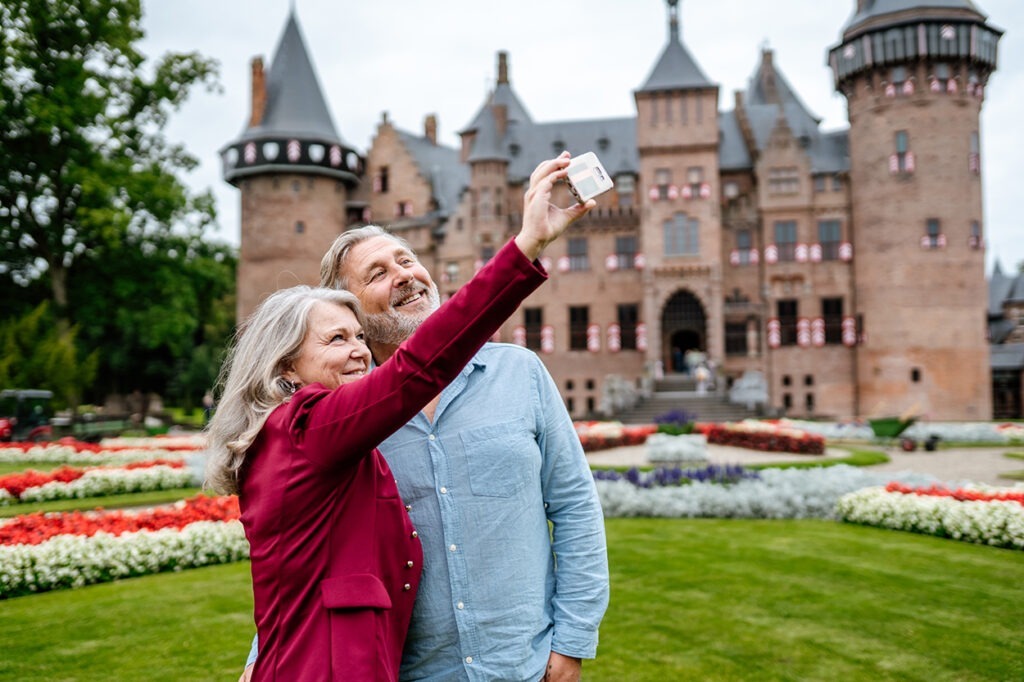
In 2000, the castle was sold to the Kasteel de Haar Foundation, and the Haarzuilens estate was acquired by the Natuurmonumenten Association. De Haar remains the most fairy-tale-like castle in the Netherlands. Many couples from the area have their wedding photos taken here, hoping it will guarantee a fairy-tale marriage.
Zuylen, Haarzuilens, Zuylestein? What’s the Connection?
It can be confusing, as there are three estates in the province of Utrecht with “Zuylen” in their names. Sometimes, visitors end up at Slot Zuylen thinking they’ve arrived at Kasteel de Haar in Haarzuilens, or vice versa. Fortunately, the two castles are close to each other, so the mistake is easily corrected. A bit farther away, at the foot of the Utrechtse Heuvelrug, lies Landgoed Zuylestein, also with “Zuylen” in its name. So, what’s the connection?
It’s no coincidence that all three estates have “Zuylen” in their names, as they were all once owned by the Van Zuylen family. Members of this family came from Germany to Utrecht in the Middle Ages, making their fortune by draining the marshes around the city. The name Van Zuylen is a Dutchified version of Sulen, an area near Cleves where the family originated. Little is known about the earliest members of the family, but we do know they were numerous and influential. By the mid-15th century, they acquired the house “Ter Haar” (named because it was built on a “hare,” a stream along the Rhine). At that time, De Haar was just a fortified tower, very different from the current castle. The Van Zuylens prospered, as they also owned a fortified castle along the Vecht, Slot Zuylen, and various estates in Abcoude, Natewisch near Duurstede, Zuylenburg near Langbroek, and Zuylestein near Leersum. The water castle Anholt, near the German border, was also briefly in the family’s possession.