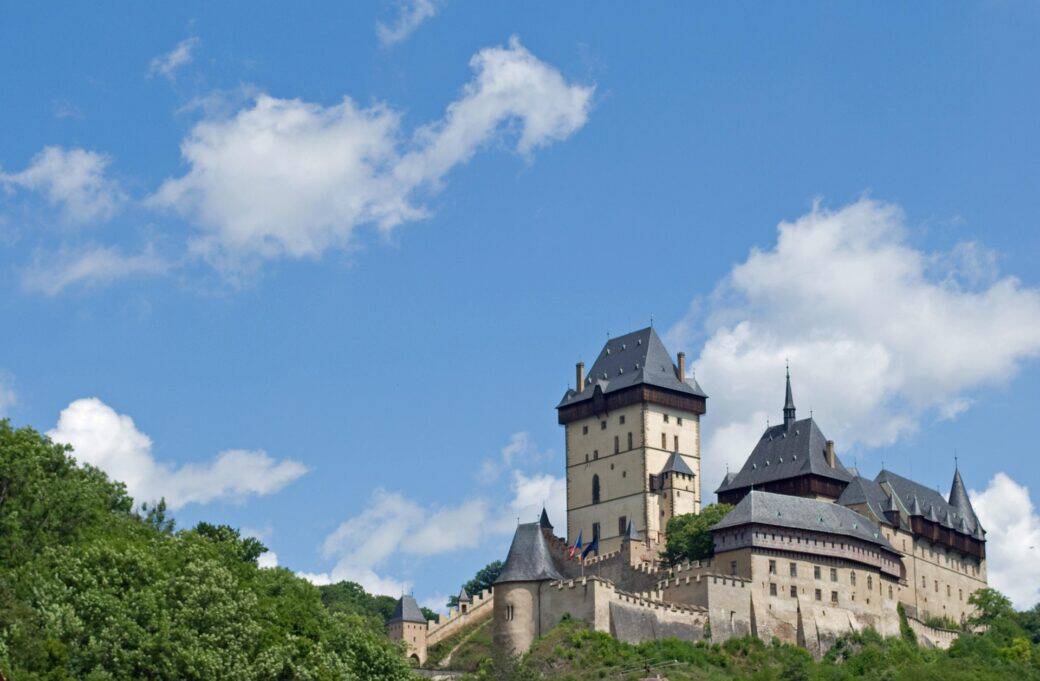
When Emperor Charles IV founded Karlštejn Castle in 1348, he had one purpose in mind: to build the safest possible place on earth for the things he valued above all else. Not gold. Not weapons. Holy relics. A remarkable reason to build a castle, but it is what makes Karlštejn unlike almost any other medieval fortress in Europe.
A castle with a very specific job
Most castles were built to protect a city, or a king, or a border. Not Karlštejn Castle in the Czech Republic. This fortress was built to protect objects. Specifically, the imperial crown jewels of the Holy Roman Empire and a collection of relics that the emperor, Charles IV, had spent years acquiring across Europe: fragments of the True Cross, thorns from the Crown of Thorns, and dozens of other sacred items that, in the 14th century, were considered to carry genuine divine power.
Charles was not a superstitious man, at least not by the standards of his time. He was one of the most capable rulers in European history, the founder of Charles University in Prague (still one of the oldest universities in Europe), and a politician of rare skill. But he was also a deeply religious man who believed that possessing these relics gave him a special authority. He needed somewhere to keep them that was worthy of what they represented.
The result was Karlštejn. Work started in 1348, and the castle was completed around 1365. From the beginning, Charles placed strict rules on who could enter its upper reaches. At certain times, women were reportedly prohibited from entering the holiest sections entirely. This was not a home in any conventional sense. It was, to put it plainly, the most important safe in the empire.
The architecture follows logic
One of the things that makes Karlštejn genuinely interesting, once you understand its purpose, is that the architecture makes complete sense. The castle rises in three distinct tiers above the valley of the Berounka river. The lower sections handled daily life and defence. Above that sat the Imperial Palace, where Charles IV stayed during his visits. And at the very top, dominating everything below it, stands the Great Tower, which is where the Chapel of the Holy Cross is located.
For many, this chapel is the main reason to come to Karlštejn. It was completed around 1365 and decorated under the direction of Master Theodoric, the leading Bohemian painter of the time. He covered the walls with 129 panel paintings of saints and angels, set into the plaster alongside semi-precious stones. It is one of the best-preserved examples of medieval sacred art in Central Europe, and it has survived in good condition precisely because the room was treated with such care for centuries.
Important: The chapel can only be visited on a separate guided tour, which must be booked well in advance.
Practical: Karlštejn has three different tour routes. Tour III, which includes the Chapel of the Holy Cross, sells out weeks ahead in summer. Book at hradkarlstejn.cz.
Seven centuries of history
After Charles IV died in 1378, the castle passed to a series of Bohemian kings. In the early 15th century, during the Hussite Wars, Karlštejn was besieged for several years. But the attackers never managed to take it. The crown jewels were eventually moved to Prague for safekeeping and the castle gradually lost its original role. Still, it remained a symbol of Bohemian identity for a long time after.
By the 19th century, Karlštejn had fallen into serious disrepair. Between 1887 and 1899, the Austrian architect Friedrich Schmidt and his Czech collaborator Josef Mocker carried out a major restoration. Much of what visitors see today reflects their work rather than the original 14th-century construction, though the Chapel of the Holy Cross was in far better condition than the rest of the castle and required less intervention.
The 19th century restoration was controversial at the time, and historians still debate how faithfully it represents the medieval original. That debate is worth knowing about before you visit. What you are seeing is partly a 19th-century vision of what a Gothic castle should look like, and partly the real thing. The chapel is, in large part, the real thing.
Fun fact: Charles IV wrote the castle’s founding charter himself in 1348. In it, he dedicated Karlštejn to ‘the glory of the Most Holy Trinity, the Virgin Mary, and the patron saints of Bohemia’. It is one of the best-preserved founding documents of any medieval castle in Central Europe.
The setting: a protected landscape
Karlštejn sits in the Bohemian Karst, a protected landscape southwest of Prague that is made up of limestone ridges, old forest and the winding Berounka river. The valley around the castle is genuinely beautiful and not overrun with visitors in the way that central Prague can be.
The village of Karlštejn runs from the train station to the castle gate, a single street of restaurants, wine shops and small guesthouses. It fills up in summer, particularly at weekends. Arriving early in the morning on a weekday, or visiting in autumn or winter, makes a real difference. The castle in snow looks exactly the way you would want a medieval castle to look.
The surrounding area is also worth exploring if you have time. The Koněprusy Caves, a few kilometres from the castle, are the largest cave system in Bohemia and contain some remarkable geological formations as well as evidence of cave bears. A guided tour takes about an hour. There are also marked walking trails through the forest connecting Karlštejn to nearby villages and the ruins of Tobolka Castle.
One small surprise: the Karlštejn area has a modest but real wine-growing tradition. Charles IV himself is said to have brought vine cuttings from Burgundy to plant on the valley slopes. Several local producers still make wine here, and the castle has its own label.
Getting there from Prague
Karlštejn is 28 kilometres southwest of Prague. Trains run regularly throughout the day from Prague’s main station, Hlavní nádraží, and the journey takes around 40 minutes. The fare is very modest. From the station, it is a 20-minute walk uphill through the village to the castle gate.
By car, the drive takes about 30 to 35 minutes via the D5 motorway, and there is a signposted car park in the village.
Karlštejn receives a lot of visitors, and that can colour how people feel about the place. Go on a summer Saturday afternoon and you will be moving in a crowd. Go early on a Tuesday in October and the experience is something else entirely.
The castle itself is interesting in direct proportion to how much you know about Charles IV and the world he lived in. If medieval history is genuinely your interest, the Chapel of the Holy Cross alone justifies the trip from Prague. If you are looking for a scenic half-day out of the city, the train ride through the Berounka valley and a walk through the village will give you that without much effort.
Practical: Karlštejn Castle is open Tuesday to Sunday, year round. Three tour routes are available, ranging from 50 to 100 minutes. The castle is closed on Mondays.
Full information and ticket reservations at hradkarlstejn.cz.