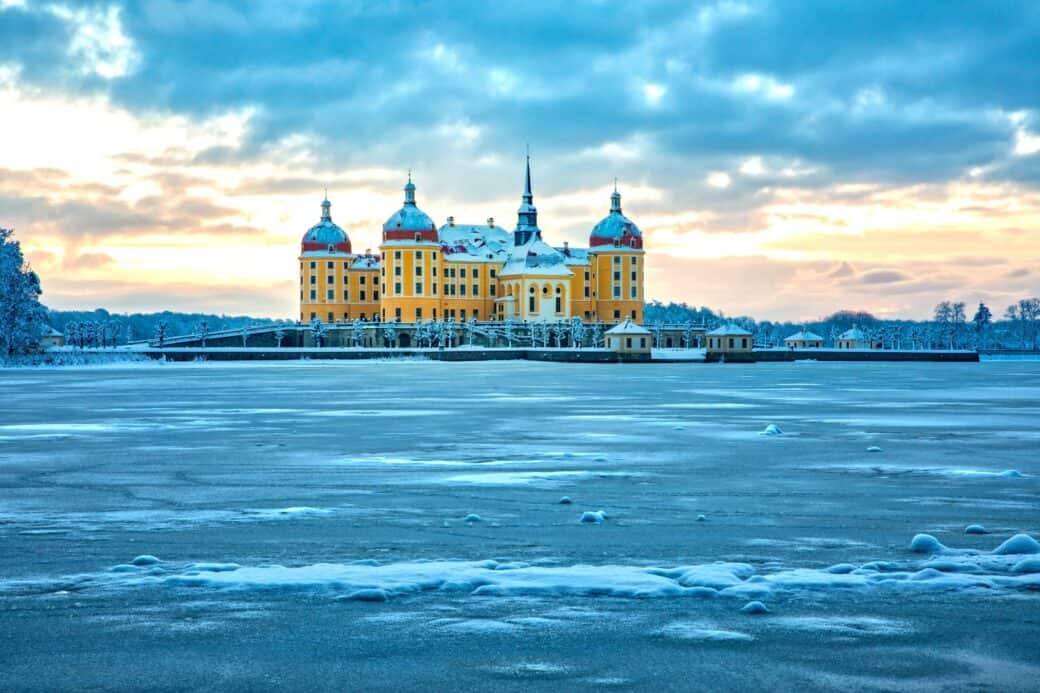
In the spring of 1825, a young man named George Niakongêtok paddled a kayak across the ornamental pond of Moritzburg Castle — and deliberately capsized it, rolling upright again before the eyes of the Saxon court. It was a feat of skill that his people had practised for generations in the freezing waters of Labrador. Here, in the manicured grounds of a Baroque hunting palace near Dresden, it was a paid performance.
Two hundred years later, Moritzburg Castle is telling his story. The exhibition Thin Ice — Inuit on Display, open from 15 May to 1 November 2026, is one of the most thought-provoking things currently showing in any castle in Europe. Based on forty years of research by curator Christian Feest — originally undertaken in collaboration with the late anthropologists William C. Sturtevant and Sally McLendon — it is also unusually well documented for a story of this kind.
A business idea born on a ship
Samuel Hadlock Jr. was a young captain from Maine who had been making a modest living shipping ice from Labrador to Martinique for a Boston merchant. Tired of that trade, he hit upon a new idea: the polar expeditions of John Ross and William Parry had recently captured the European public imagination, and Inuit were suddenly fascinating to audiences across the Atlantic world. Why not display them?
In September 1820, a Scottish trader named McPherson in Grady Harbour agreed to let Hadlock hire two of his employees for a year. The first was George Niakungitok, who had grown up in the Moravian mission of Hoffenthal (Hopedale) and had learned to read and write alongside his Christian education — and who, to the considerable chagrin of the Moravians, had left the mission because he wanted to see the world beyond Hopedale. The second was Mary Coonahnik, a single mother with a five-month-old son. The permission of their parents was sought and obtained.
This detail matters. George was not kidnapped. He chose to go.
The Liberators Who Made Things Worse
Hadlock’s show was an immediate success in New York, built largely around George’s extraordinary kayaking demonstrations. But a Moravian pastor in the city, learning of George’s background, suspected exploitation and organised a group of philanthropists to “liberate” the two Inuit and return them to Canada.
In February 1821 Hadlock was brought before the mayor of New York, charged with trespass, assault and battery, and false imprisonment. Unable to raise $4,000 in bail, he was jailed. George and Mary were placed in the care of a respectable innkeeper named Charles Butler.
What happened next complicates the simple story of rescue. Mary’s baby son Ekeloak died while in Butler’s care. The innkeeper then took the two Inuit to New Jersey…and began exhibiting them himself, for his own profit. It was only a few months later, in Philadelphia, that Hadlock obtained a habeas corpus to reclaim them. George and Mary testified before the court that they wanted to stay with the captain.
The liberators, it turned out, were not obviously better than the man they had liberated them from.
Touring Europe: Kings, artists and a Maori technique
Instead of returning George and Mary to Labrador when their year’s contract expired, Hadlock continued his tour through England, Wales and Ireland for almost three years. When Mary died somewhere in northern England, Hadlock had to replace her. First with, in the exhibition’s words, a “drunken gipsy,” and when that deception became too obvious, with a sober Roma woman dressed in the late Mary Coonahnik’s sealskin parka. This second woman would continue to convincingly impersonate the original Mary for the next eight years.
Hadlock’s show expanded. Inspired by a Scottish competitor, he added a “museum” of North American and Pacific artefacts, specimens of natural history (including a “mermaid”), and a “Panorama of the Polar Regions.” In August 1823 he hired two young Maori aristocrats who had come to England to buy weapons for the wars in New Zealand. When one of them, named Kayatera, died in Leamington, his companion taught Hadlock the Maori technique of preserving heads. Hadlock promptly applied this skill to preserve his companion’s head after the latter’s death in Leeds, mounting it on a cast of his body and displaying it as a “cannibal chief from the South Pole.”
In 1824 the show moved to Germany. Over the next sixteen months, Hadlock performed for the kings of Prussia, Saxony, Bavaria and Württemberg. In Berlin he fell in love with the daughter of a factory worker and married her despite her parents’ reservations. She would later be known in Maine as “the Prussian Lady.”
George, meanwhile, was visited in Berlin and Dresden by two of his former Moravian teachers, who urged him to return to Labrador. He was glad to see them and to speak Inuttut again, but declined, at least for now. He had begun making drawings of scenes from his homeland, selling them to visitors of the show. The exhibition at Moritzburg displays all of his known works. He and the Roma Mary also sat for portraits by the then famous sculptor Johann Gottfried Schadow, who included them in his book on national physiognomies, alongside, as it happens, the preserved head of the Maori chief.
The day at Moritzburg
On 10 March 1825, the show arrived at Moritzburg Castle. What took place that day is recorded in remarkable detail. A Christian hymn was sung in Inuktitut in the castle’s ceremonial halls. A small cart pulled by a sled dog was driven through the royal apartments. George demonstrated his spear-throwing by hitting coins placed at measured distances. And then, on the castle pond, before the King of Saxony and thousands of spectators, he performed a full kayak capsize, rolling smoothly upright in the cold Saxon water.
A copper engraving was made of this moment. It is one of the centrepieces of the exhibition.
The aftermath
When the show reached Stuttgart in September 1825, George fell ill. Hadlock, concerned about his investment, prevented him from reading his New Testament in Inuttut. He did not want the sick man troubled by reading, he said. Within days of arriving at the next stop in Strasbourg, George died of pneumonia. He was only 26 years old.
Hadlock preserved his head using the Maori technique he had learned in Leeds, displayed it first in a separate room, and later in Paris alongside Mary. In February 1826, the Paris police demanded the burial of George’s head at the Montmartre cemetery. Hadlock argued that the body had already been interred in Strasbourg. Eventually he was permitted to continue the display until the show closed on 20 March 1826, four days after the birth of his daughter by the Prussian Lady. “Now this endes my exibiting Indians,” he wrote in his journal.
Unable to sell his collection of artefacts, he donated it to the King of Prussia. Parts of it have survived in the Ethnological Museum Berlin and are featured in the exhibition.
Hadlock returned to Maine, built a house on Great Cranberry Island, and shortly after the birth of a son in September 1827, sailed for Greenland on the schooner Minerva and never came back. He was later reported to have been caught in a blizzard and found frozen, his rifle at the ready.
The woman who became a star
The story does not end with George’s death. Nor with Hadlock’s disappearance. When the latter left Paris, he handed a kayak, a sledge, the panorama, and a collection of artefacts to his interpreter Gustav Karsten, who continued the show under the captain’s name.
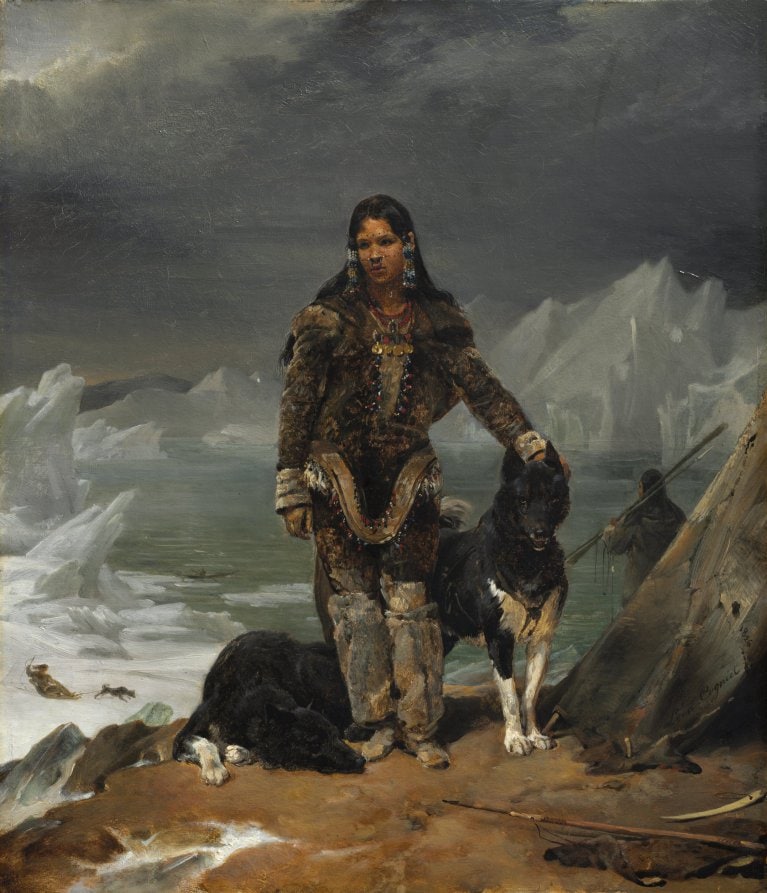
Mary also joined Karsten. With her supposed “husband” no longer diverting the audience’s attention, the she became a star in her own right. She was painted in oil by French painter Léon Cogniet and drawn by the German Moritz Rugendas. Poems were written in her honour. She performed at a gathering of Parisian intellectuals and bureaucrats, and is said to have visited King Charles X at the Château de Saint Cloud. After touring France and Belgium, she and Karsten were last heard of in Aachen in July 1830. In 1833, there was a rumour that an “Esquimaux woman” had died in Ghent.
Whether that was her, nobody knows.
The exhibition in Moritzburg Castle
Thin Ice presents all of this without editorial verdict. The exhibition, says curator Margitta Hensel, deliberately refrains from passing judgement. “Everyone must decide for themselves what effect such a moving story has on them. We don’t need to make accusations — first we need to look at what happened, when, and why.”
We feel this is the right approach. This is a story full of people who are difficult to place neatly on a moral scale. Hadlock was exploitative and sometimes callous, but George chose to be there and chose to stay. The philanthropists who “liberated” the Inuit managed to get Mary’s baby killed and then exhibited the survivors themselves. The Moravian missionaries educated George and gave him language and skills, but they tried to contain him within their vision of a model Christian community. George drew pictures of his homeland throughout his journey across Europe, in the middle of a show that reduced his culture to a performance. The Roma Mary outlasted all of them, triumphed, and then disappeared into history on her own terms.
Moritzburg Castle is perhaps not a place most visitors associate with this kind of history. It is best known as one of the finest Baroque hunting palaces in Germany. Thin Ice is something else entirely: serious, carefully researched, and built on a story that happens to have its most precisely documented moment right here, on this pond, on a cold March morning two hundred years ago.
Through the gallery window, the water still glitters. The same pond. The same castle. A completely different story than the one most visitors expect to find.
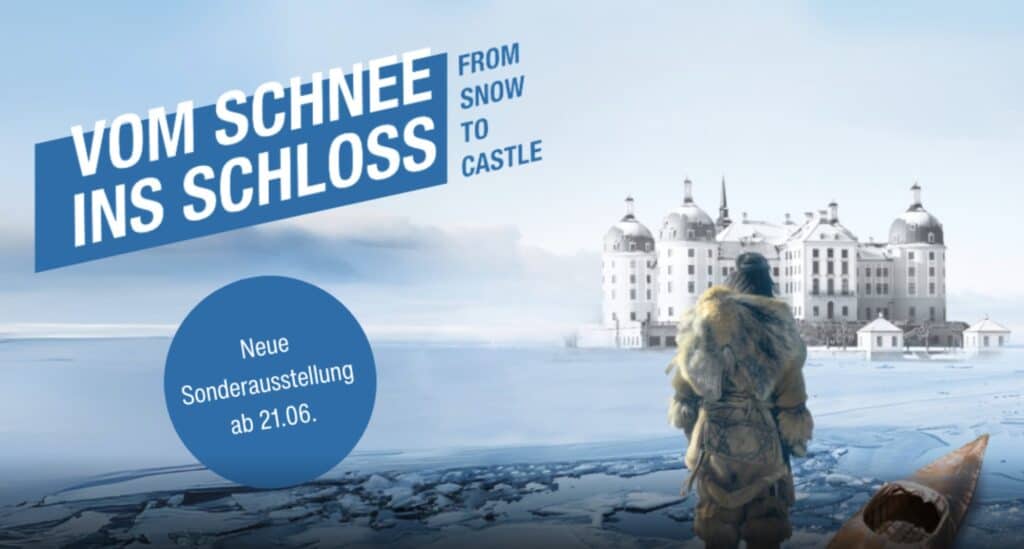
Thin Ice — Inuit on Display 15 May – 1 November 2026 Moritzburg Castle, Schloßallee 1, 01468 Moritzburg (near Dresden) Open daily 10:00–18:00 Adults €12 | Concessions €10 schloss-moritzburg.de
Sources: Eva Gaeding, MDR Kultur (May 2026); Christian Feest and Margitta Hensel, exhibition catalogue Dünnes Eis / Thin Ice, Moritzburg Castle, 2025–2026.