


Most people who have heard of Schwerin Castle know it for one image: a fairy-tale silhouette rising from its own island, so photogenic it is routinely mistaken for a film set. The accolade is deserved: it became a UNESCO World Heritage Site in 2024. Schwerin earns every visitor it gets. But Bundesland Mecklenburg-Vorpommern hides a scattering of estates within a short drive that also deserve your attention. These five reward the detour.
Schwerin Castle
Rising from its own island in the Schweriner See, this is the kind of silhouette that looks designed rather than built, and it very nearly was: successive dukes rebuilt it into its present Historicist form in the 1840s and 50s, drawing openly on the Loire châteaux for inspiration. It became a UNESCO World Heritage Site in 2024 and was the seat of the state parliament of Mecklenburg-Vorpommern. For readers of Dutch royal history: it was the childhood home of Duke Heinrich Wladimir Albrecht Ernst of Mecklenburg-Schwerin, better known as Prince Hendrik, the consort of Queen Wilhelmina of the Netherlands. His marriage would prove a difficult one, sidelined from Dutch political life and financially dependent on a wife he grew estranged from, which lends the fairy-tale exterior an undertone of quiet melancholy for those who know the story.
Located centrally in Schwerin. Palace museum open daily; the surrounding Schlossgarten is freely accessible.
Official website: schloss-schwerin.de
Schloss Bothmer
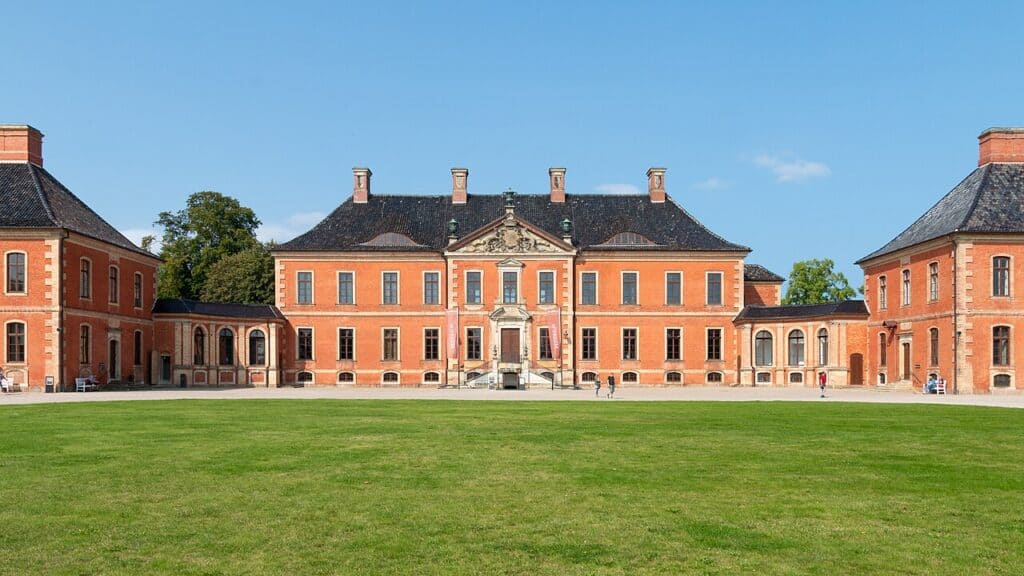
Built between 1726 and 1732 for Count Hans Caspar von Bothmer, this is the largest Baroque-era country house ensemble in Mecklenburg-Vorpommern, its brick façade combining Dutch and English architectural traditions rather than the ornamentation typical of German Baroque. Bothmer himself never saw it finished — his career as a Hanoverian diplomat kept him in London, where he occupied a townhouse on Downing Street that came to be known, briefly, as “Bothmar House,” before it was absorbed into what is now Number 10. The state acquired the 13-building ensemble in 2008 and carried out a €36 million restoration with EU support; the palace reopened in 2015 with a museum tracing Bothmer’s diplomatic life, alongside a 250-year-old lime avenue considered a natural monument in its own right.
Located roughly 65km northwest of Schwerin, near Klütz. Guided tour through more than 20 rooms, approximately 75 minutes, audio guide in German and English.
Official website: mv-schloesser.de
Schloss Wiligrad

Perched on a steep bluff above the Schweriner Außensee, barely 15km from Schwerin by bicycle, Wiligrad is one of the youngest castles in Mecklenburg — built in 1896–98 for Duke Johann Albrecht in a self-consciously historical style its architects called “Mecklenburg Renaissance,” rich with terracotta ornament. Despite its modest, rural setting, it hosted genuine international diplomacy in its day, including a stay by Kaiserin Auguste Viktoria during imperial manoeuvres in 1904. The surrounding landscape park, laid out with five kilometres of paths threading between rhododendrons and exotic trees, has been painstakingly restored to its original plan.
A redactional note: as of this writing, Schloss Wiligrad is closed for renovation and the interior cannot be visited. The park remains open to the public, and the nearby café continues to operate.
Located roughly 15km north of Schwerin, near Lübstorf. Reachable by bus from Schwerin Hauptbahnhof or by bike along the lake.
Official website: mv-schloesser.de
Schloss Güstrow

One of the most significant Renaissance palaces in northern Europe, and unlike Schwerin’s much-restyled 19th-century silhouette, largely preserved in its original 16th-century form. Duke Ulrich commissioned the rebuild after a fire in 1557, hiring the Silesian-Italian architect Franz Parr, whose work still gives the west and south wings their unmistakable Renaissance profile. Its most colourful resident arrived by force of arms rather than birthright: the famous Imperial generalissimo Albrecht von Wallenstein lived here from 1628 to 1630 after defeating Mecklenburg’s Danish allies, briefly ruling the duchy in the exiled duke’s place.
A redactional note: Schloss Güstrow’s museum is currently closed for extensive restoration work. The Renaissance-style palace garden, one of the few surviving examples of its kind in Germany, remains freely accessible.
Located roughly 60km east of Schwerin.
Official website: mv-schloesser.de
Schloss Ludwigslust

Mecklenburg’s own answer to Versailles, and it rather insists you notice the resemblance. Duke Friedrich had it built between 1772 and 1776 as the new ducal capital’s centrepiece, its E-shaped Late Baroque façade fronted by a monumental cascade fed by a purpose-built canal system running for kilometres — engineering theatre in the service of pure spectacle. The palace served as the seat of government until 1837 and remained inhabited by the ducal family until 1945, which explains why its interiors, above all the gilded Golden Hall, feel less like a museum reconstruction and more like a residence someone only recently left. A mausoleum in the surrounding 120-hectare park holds the remains of Grand Duchess Elena Pavlovna, daughter of Tsar Paul I — one more thread linking this quiet Mecklenburg town to the wider network of European courts.
Located roughly 35km south of Schwerin.
Official website: visit-mv.com
A note on the Staatliche Schlösser, Gärten und Kunstsammlungen Mecklenburg-Vorpommern
Every castle in this piece falls under the care of a single state institution: the Staatliche Schlösser, Gärten und Kunstsammlungen Mecklenburg-Vorpommern. Established on 1 January 2018 by an act of the state parliament, the body brought together heritage responsibilities that had previously been scattered across the finance ministry, the state’s building and property agency, and the Staatliches Museum Schwerin.
It now oversees eight castles, nine castle gardens, and the Staatliches Museum Schwerin, making it the most historically significant cultural institution in Mecklenburg-Vorpommern. Its remit runs from architectural conservation and restoration to research, public education and event management, with the explicit aim of keeping the region’s ducal art collections and garden heritage authentically preserved while remaining genuinely open to visitors. The Staatliches Museum Schwerin itself has held the dukes’ art collections open to the public for around 140 years, a continuity few German regional museums can claim. Among its holdings is one of Europe’s most extensive collections of Dutch Golden Age painting.
Official website: ssgk-mv.de (also reachable via mv-schloesser.de and museum-schwerin.de)


