When you think of castles in Poland, what comes to mind first? Many people will mention Wawel Castle in Krakow. It’s an impressive castle, but there are many more. Here are 5 you shouldn’t miss when visiting Poland.
Malbork Castle
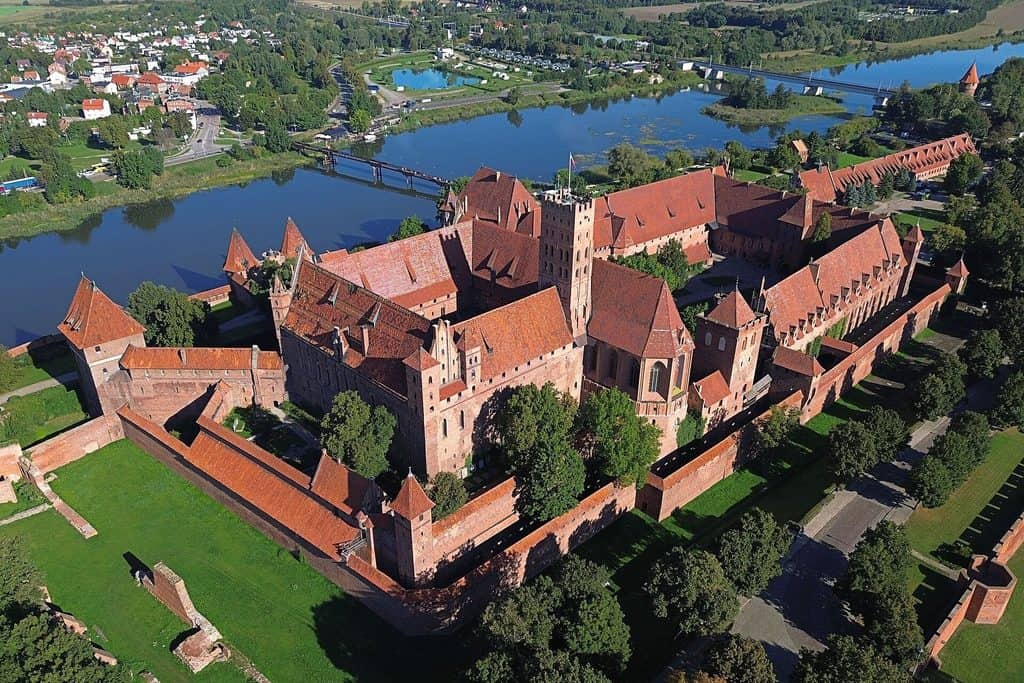
On the banks of the Nogat River, 45 kilometres south-east of Gdańsk, Malbork Castle is an enormous masonry fortress of 30 million red bricks spanning 21 hectares with 42 halls. It constitutes one of the largest medieval castles in the whole of Europe. Malbork was built by the Teutonic Knights in the 13th century, it served as the headquarters of the Order and was designated a UNESCO World Heritage Site in 1997.
The castle consists of three defensive rings: the Lower Castle (outer administrative complex), the Middle Castle (guest quarters and officials), and the High Castle (Grand Master’s residence, chapter hall, dormitory, and refectory). You can move through courtyards, vaulted passages, and reconstructed interiors that convey the order’s monastic severity and military ambition.
The Second World War severed the castle almost beyond recovery. More than half of the structure was destroyed during the Soviet advance in 1945; however, Polish authorities undertook a decades-long restoration beginning in 1946. Today’s Malbork stands as a testament to post-war heritage reconstruction in Eastern Europe, a narrative that distinguishes it from Western castles that escaped such devastation. The castle is accessible via day-trip from Gdańsk or as a multi-hour excursion; exhibitions within its chapels, halls, and storage rooms chart the order’s regional dominance and internal life.
Practical notes: Museum-standard infrastructure; modern café and gift shop. Allow 3–4 hours minimum. Best visited in May–September; book timed entry in high season.
Official website: zamek.malbork.pl
2. Książ Castle
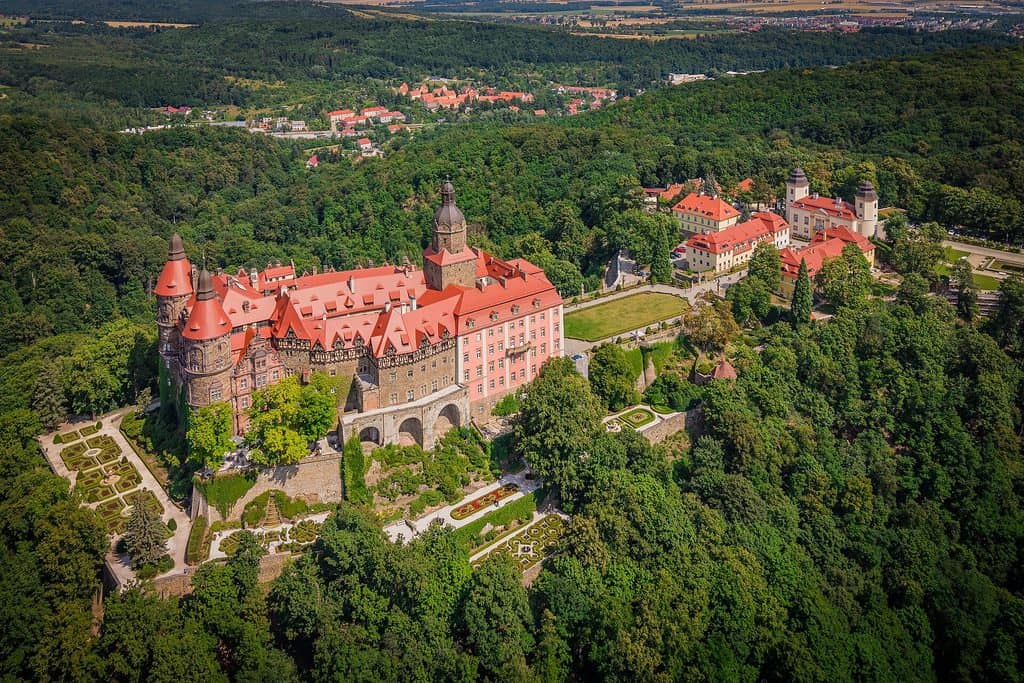
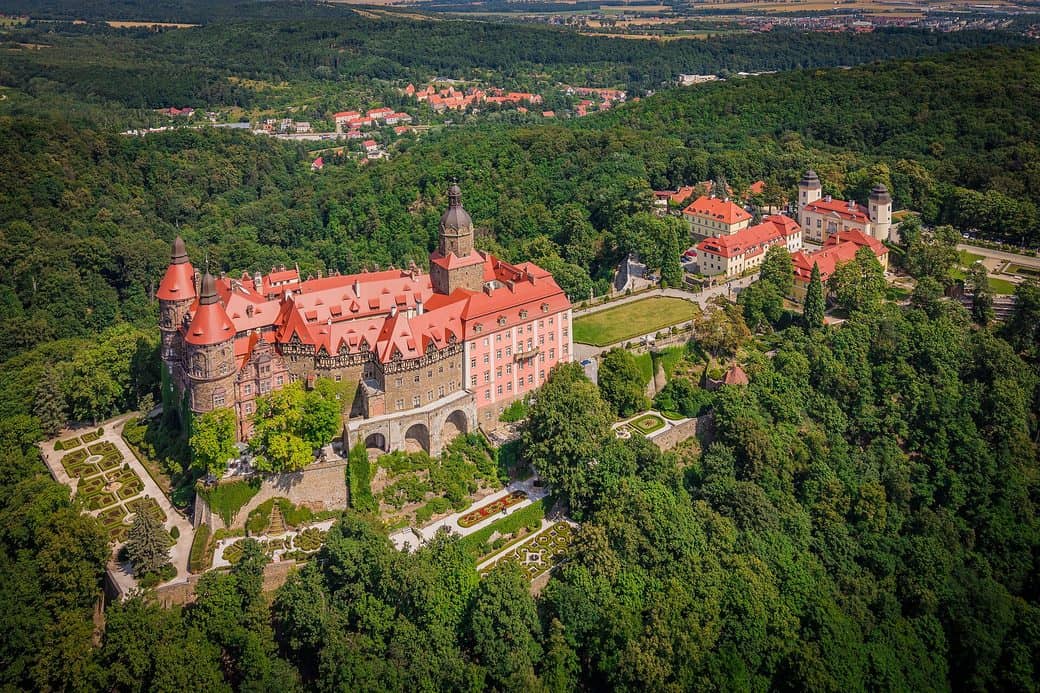
Located in Lower Silesia north of the town of Wałbrzych, Książ Castle (Schloss Fürstenstein in German) stands atop a steep cliff and comprises over 400 rooms, making it the third-largest castle complex in Poland and one of Europe’s largest. Originally constructed around 1288–1291 under Bolko I the Strict, the castle underwent continuous modification through the Renaissance and Baroque periods.
The Prussian Hochberg family dominated Książ from the 16th century onward, transforming it into a neo-classical and neogothic mansion that hosted crowned heads and statesmen. Famous rulers like Frederick the Great, Kaiser Wilhelm I, Tsar Nicholas I and even Winston Churchill all visited the castle during the Hochberg era.
The Nazi occupation of Poland diverted Książ into something far darker. In the final years of the Second World War, the castle became part of the Riese Project, an elaborate underground Nazi military-industrial complex. Today, you can explore the castle’s main apartments and the excavated tunnel sections, a reminder of the region’s dark history of the 20th-century.
The restored castle now functions as a hotel, museum, and events venue, with carefully curated rooms displaying period furnishings and architectural detail. The adjacent Palm House is one of Europe’s most impressive horticultural structures.
Practical notes: 80 kilometres south-west of Wrocław; accessible by car via scenic Owl Mountains region. Overnight accommodation and fine dining available on-site. Plan a full day to explore grounds and castle interiors.
Official website: ksiaz.walbrzych.pl
3. Ruins of Krzyżtopór

In the Świętokrzyskie Mountains near the small town of Ujazd, you can find one of Europe’s most enigmatic castle ruins. Built between 1619–1644 by nobleman Krzysztof Ossoliński, Krzyżtopór it is said to be the largest palace complex in Europe until Versailles was constructed. Yet this vast structure was inhabited for barely more than a decade.
The castle’s baroque design incorporated number symbolism: it supposedly had as many windows as days in a year, as many rooms as weeks, as many great chambers as months, and as many round towers as quarters. In 1655, the castle was plundered by Swedish forces during the Deluge, and in 1770 it was destroyed by Russian soldiers; since then, it has remained a picturesque ruin.
Today, Krzyżtopór attracts history enthusiasts and urban explorers. The ruins host tournaments and historical festivals featuring period reenactment. Walking through its roofless chambers and collapsed courtyards, you witness the ruins of a nobleman’s unchecked ambition. The site is open to visitors year-round and requires no tickets.
Practical notes: 40 kilometres south-east of Kielce; accessible by car from Kraków (2 hours) or Wrocław (3 hours). Bring sturdy footwear; parts of the structure are unstable. Best visited in clear weather for photography.
Official website: https://krzyztopor.webpark.pl/
4. Moszna Castle
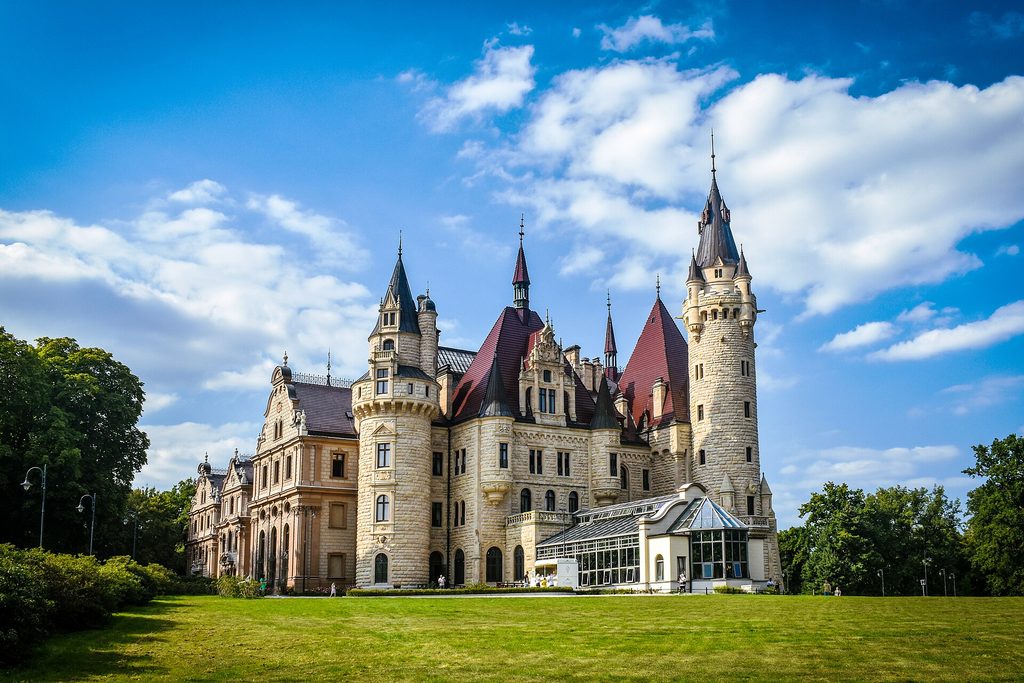
Moszna Castle, located in the Opole Voivodeship in south-western Poland, is a masterwork of romantic, eclectic architecture. It was completed in its current form between 1896 and 1914 and is perhaps the closest European parallel to the fantasy castles that populate children’s literature.
The structure boasts 365 rooms and 99 towers. A number that, according to legend, was deliberately limited by a binding Prussian law: the 100th tower would have triggered mandatory maintenance of a military garrison at the owner’s expense. The architecture blends Baroque, Neo-Gothic, and Neo-Renaissance idioms in a composition that feels simultaneously deliberate and dreamlike.
The castle’s transformation into its current romantic form occurred under the Tiele-Winckler family, a Silesian aristocratic lineage with Prussian connections, in the 19th century. In 2021, Moszna was recognized among Poland’s ten most romantic locations by the Polish Tourist Organization and ranked in the top 15 most beautiful castles in Poland.
The castle is now a hotel and event venue, with parts of the interior available for public touring during daylight hours. The surrounding park—with winding pathways, artificial lakes, and mature forests—reinforces the estate’s storybook character. Visitors report that standing in the castle’s gardens at dusk feels less like historical tourism and more like stepping into an illustration.
Practical notes: 35 kilometres south of Opole; roughly equidistant from Kraków (3 hours) and Wrocław (2 hours). On-site dining and accommodation. Plan 2–3 hours for garden and ground-floor exploration.
Official website: mosznazamek.pl
5. Nowy Wiśnicz
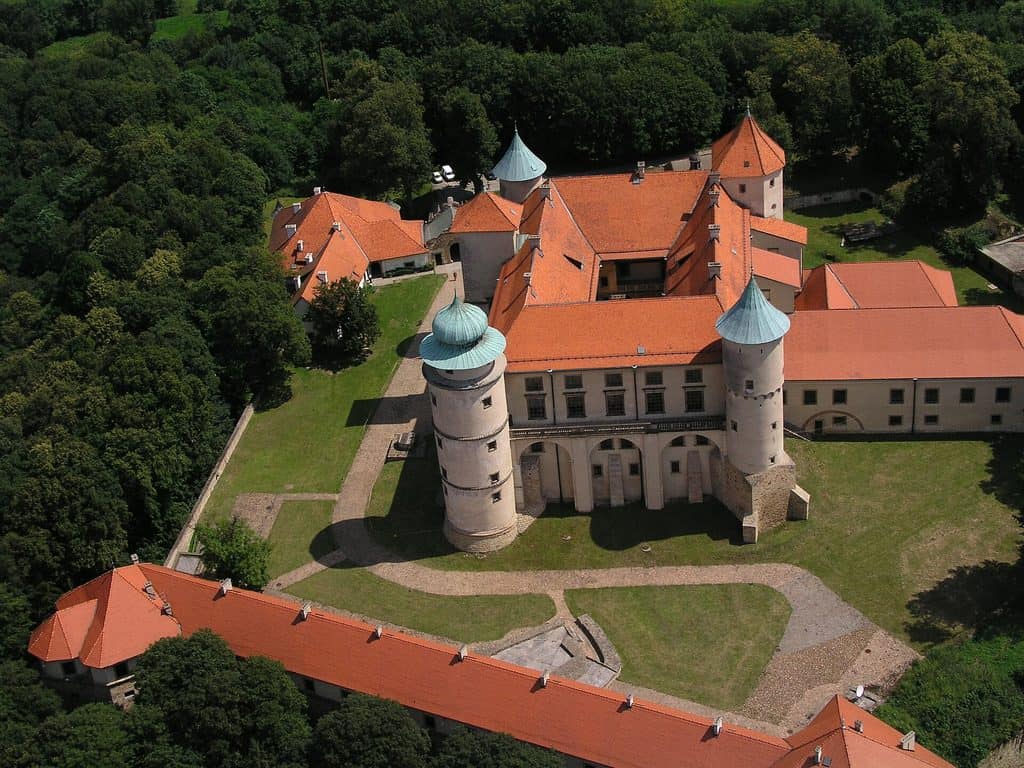
On a forested hill above the Leksandrówka River, stands Nowy Wiśnicz, a castle whose every stone speaks of Polish aristocratic ambition. The original fortress was raised in the second half of the 14th century by Jan Kmita. In 1593, Sebastian Lubomirski acquired the estate; his son Stanisław founded the adjacent town of Nowy Wiśnicz in 1616.
Between 1615 and 1621, under Stanisław Lubomirski and architect Maciej Trapoli, the castle underwent a profound baroque reconstruction that included four-winged architecture, bastioned fortifications, and a baroque entrance gate. This was not mere enlargement; it was a declaration of dynastic power. Lubomirski founded the adjacent Carmelite monastery (1631–1635) to commemorate Polish victory over the Turks at the Battle of Khotyn (1621).
The castle’s history after the 17th century is a story of fragmentation and recovery. A catastrophic fire in 1831 left it in disrepair; restoration began in 1928 but was interrupted by the Second World War; from 1949 onward, the Lubomirski Foundation and state authorities continued renovation. Today, the fortress houses a museum presenting the building’s history, and visitors can access a vast ballroom, gilded plafond chamber, chapel, and crypt containing six sarcophagi, including that of Stanisław Lubomirski.
Practical notes: 40 kilometres south of Kraków, accessible by car in under one hour. Museum-standard amenities. Allow 2–3 hours.
Official website: zamekwisnicz.pl
Planning a Polish Castle Route
These five castles form two logical itineraries. The Southern Loop (Krzyżtopór, Nowy Wiśnicz, and Moszna) can be driven in 3–4 days from Kraków, with time for gardens and interior exploration. The Silesian & Northern Route (Książ and Malbork) suits a longer northern Poland journey, pairing Wrocław-area bases with a Gdańsk excursion.
For Western travellers, the revelation lies not in the castles’ size alone—though several rank among Europe’s largest—but in the architectural eclecticism, the density of political narrative, and the frankness with which these estates acknowledge war, occupation, and reconstruction. These are not palaces of untouched splendour. They are palaces that have been shattered and rebuilt; castles that have housed monks, generals, Nazis, and communists. That layered complexity is what sets Polish castle tourism apart.