

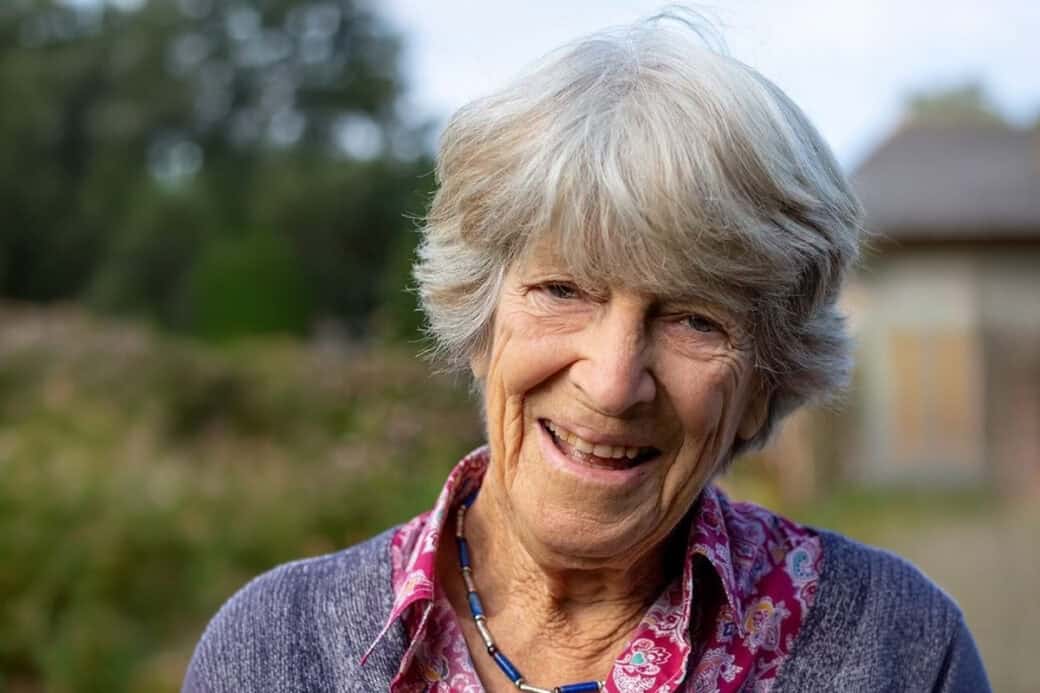
For a great part of the twentieth century the walled kitchen garden was maybe the least regarded part of a country estate. Many owners demolished the glasshouses and walls and some even sold the land. Thanks to the tireless efforts of illustrator Susan Campbell, the walled garden has once again become the focus of attention. A true heritage hero.
Trained illustrator
Campbell was born as Susan Benson in Ruislip, Middlesex, on 14 September 1931. She studied at the Slade School of Fine Art and worked as an illustrator for The Sunday Times and The Observer. Her first book illustrations appeared in Nell Dunn’s Up the Junction. In the 1970s she turned to food, writing with Caroline Conran on Poor Cook (1971) and Family Cook (1974). Maybe that’s how her interest in walled kitchen gardens began. She wanted to know what the gardeners grew, when they picked it, and how it reached the table.
A History of Kitchen Gardening

Campbell’s first garden book, Cottesbrooke: An English Kitchen Garden, appeared in 1987. It recorded one garden through a year, in detail, with her own drawings doing the explanatory work. Her next book, Charleston Kedding: A History of Kitchen Gardening, followed in 1996. The title names an estate that never existed. Campbell built a composite garden so she could explain every element in one place, and she drew her real evidence from Pylewell Park, near Lymington in Hampshire, close to her home in the New Forest. The book covers walls, flues, frames, pits, glasshouses, forcing, rotation and labour. A revised edition dropped the invented name and appeared as A History of Kitchen Gardening, republished by Unicorn in 2015. She also wrote a short Shire volume on walled kitchen gardens for a general readership.
Darwin’s diary
In 1986, she discovered a previously unrecorded gardening diary belonging to the Darwin family in a Christie’s catalogue, just one day before the auction, and it turned out to have been withdrawn from the sale. Fourteen years later, she nevertheless managed to acquire it. Dr Robert Darwin, father of Charles, began the diary at The Mount in Shrewsbury on 1 September 1838, and his daughter Susan kept it going until 1865. It lists the plants grown there, ornamental and exotic, and it records the experiments Charles ran in his father’s garden after the Beagle. Campbell published it in 2021 and gave the manuscript to Cambridge University Library.
The Walled Kitchen Gardens Network
In 2001 Campbell and others organised the first Forum about Walled Kitchen Gardens at Hellens in Herefordshire, England. Together with the historian Fiona Grant she decided there to set up an online newsletter, the Grapevine, which evolved in the Walled Kitchen Gardens Network. The approach was deliberately modest. No grand institution, no membership hierarchy, simply a way for owners, head gardeners, volunteers and researchers to find each other and compare notes.
Since then, the network has reached members in the United Kingdom, Europe and beyond. It runs a Garden Finder directory, publishes advice and organises meetings and training. The annual Forum continues: Audley End hosted it in 2025, and Holkham Hall in Norfolk in 2026. Restoration projects that once operated in isolation now share techniques, suppliers and mistakes.
English Heritage recognition
In 1993 English Heritage commissioned Campbell’s thematic report on walled kitchen gardens, which guided their inclusion on the Register of Parks and Gardens of Special Historic Interest. She served on the Conservation Committee of the Garden History Society and later as Vice-President of the Gardens Trust. She advised restorations at Tatton Park and Hampton Court.
In 2023, a year before her death at 92 in 2024, she finally received the recognition she deserved when the Royal Horticultural Society awarded her the Veitch Memorial Medal. Peter Hughes, chairman of the Gardens Trust, put the case plainly after her death: “Susan Campbell’s work focussed attention on the significance of walled gardens and, through her work, in recent years walled gardens around the country have been restored and put to new uses.”
Campbell’s legacy
Walled kitchen gardens are not a British peculiarity. They stand behind manor houses in the whole of Europe. Almost everywhere they share the same fate. They are the last part of an estate to be restored and the first to be turned into a car park. Campbell’s achievement lies in the fact that she emphasized the fact that documentation comes first. A garden that nobody has recorded cannot be defended, because there is nothing to point at. That method explains why her 1993 report for English Heritage mattered more than any single restoration. It also explains why she carried the argument beyond Britain, as a co-initiator and co-president of the European Symposium on the conservation of historic fruit and kitchen gardens.
Her legacy now sits in two places. One is the archive and working library at Hestercombe House in Somerset, where photographs of more than 600 gardens survive as evidence, in many cases after the walls themselves have gone. Hestercombe already holds significant garden records, including material on the Bampfylde landscape and on the formal garden designed by Gertrude Jekyll and Edwin Lutyens. The other is the Walled Kitchen Gardens Network, still meeting every autumn, still publishing the Grapevine. Together they prove a modest point with immodest consequences. A newsletter and a stubborn illustrator moved an entire category of heritage from neglect into the record.


