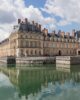
German entrepreneur Peter Löw has restructured more than 300 companies across 70 countries. He teaches economic philosophy at a pontifical university and holds two doctorates. He is also a writer, a licensed pilot, a lieutenant colonel in the German Bundeswehr, and, above all, a dedicated family man. For the past two decades, he has poured his energy and resources into rescuing forgotten monuments throughout Europe. We spoke to Dr. Löw via video call from his monumental office in Munich: the Palais Seinsheim, where Mozart once stayed.
Most people who build a fortune are content to sit back and enjoy it. Not Peter Löw. He appears constitutionally incapable of such restraint. He divides his time between Munich and Hofhegnenberg Castle, a thirteenth-century fortress he rescued from three decades of neglect, painstakingly restored, and now shares with his wife and seven children. In what time remains, he teaches, writes, and devotes his energy and resources to saving neglected monuments across the whole of Europe. Thanks to his aide Theodor Himmel, I had the pleasure of speaking directly with the man himself via video call.
There is a brief audio problem before things settle. Once resolved, we proceed in a mixture of his German, my imperfect German, and stretches of English when the vocabulary outpaces me. After exchanging pleasantries, during which I congratulate him on his recent high Austrian state honours, the conversation begins.
Throughout Europe, different approaches to heritage preservation exist. What, in your view, is the German approach?
“Germany has lived through many ruptures. After the First World War, preservation became secondary; people were focused on survival, not monuments. Then, after the Second World War, the debate split into two camps. One side wanted to demolish the old and modernise the architectural landscape. The other called for reconstruction and restoration. In my view, both were sincere, and both caused damage in their own way.”
“From 1970 onward, what I would call nostalgia began to reassert architectural values, a stronger turn back toward what had been built before. This was a reaction to the road-building and modernisation of previous decades. By now it is common sense. A historic building works like a vintage car: drive one through a village and everyone admires it. Announce a castle restoration and everyone approves. The real difficulty is persuading people to invest before the arrival, not after.”
Europe’s cities and regions are increasingly home to people with no ancestral connection to the local past. Can heritage speak to those communities too?
“Particularly for those people. Look at what happened in ancient Rome, where populations from across the entire empire lived together. Or London in the nineteenth century, absorbing people from across the colonies. For all of them, the monuments were how they came to understand the culture they had entered. My own staff at the European Heritage Project come from many countries. They find it extraordinary to encounter a German castle or monastery for the first time. They have no inherited connection, yet they want one, and the building provides it.”

“When a castle falls into decline, the well-being of the entire surrounding region declines with it. People sense the neglect and absorb a kind of shame they cannot always name. Restore it, and something reverses. The community begins to claim the building as its own. Guests are shown it with pride. By restoring old stones you are doing something psychologically far more significant for a society than most people realise. You give them pride, self-confidence, and a living relation to their own history.”
You describe yourself as a caretaker rather than an owner. What do you mean by that?
“Well, the distinction matters because it changes the obligation entirely. An owner can sell, remodel, or walk away. A caretaker receives a building in trust and passes it on — intact, perhaps a little improved — to the next generations.”
This philosophy shapes even his first encounter with a property. Löw assesses a building as much by instinct as by survey: reading a worn stone threshold or a vaulted ceiling blackened by centuries of smoke, sensing whether a place still has something to say after decades of neglect. Whether this is mysticism or methodology, he does not say. It is perhaps both.
“By restoring old stones you are doing something psychologically far more significant for a society than most people realise. You give them pride, self-confidence, and a living relation to their own history.”
By now the European Heritage Project spans more than two dozen properties across Europe and beyond: palazzi in Venice, a baroque house in Vienna, protected townhouses in Baden-Baden, a former convent with olive and lemon groves in Tuscany, a townhouse in Valletta, a wine estate in Stellenbosch, a crumbling manor on one of the Shetland Islands, and, on Lake Garda, Limonaia San Sebastiano — a medieval lemon house that is the subject of a separate feature on this site. The range is striking.
The European Heritage Project has properties in many countries, from the Shetland Islands to South Africa. Is there some logic behind that?
“No. There is no logic. We have built up a certain reputation, and people now approach us. They come with projects and say: look, we have a problem in our region, we have a significant building and nobody is really taking care of it.”
Can you give an example of how that works in practice?
“Yes. There was a French castle recently offered to us. It had been on the market for €3.5 million. The owner was a baron who had received approaches from investors who wanted to build private houses in the grounds and use it for weddings. He could not reconcile that with his conscience or his family tradition. So he called us, because he knew we carry out real renovations and respect the original appearance of these houses. In the end he sold it to us for €1.5 million. He intentionally left two million on the table, just to have the peace of mind that his castle was in good hands.”
When you take on a property, what is your approach to the restoration itself?
“We choose a specific year and restore the building to the state it was in at that time — the decorative elements, the floors, the furniture, the paintings. Everything must be consistent with that period. At the moment I am working on a classical castle near Freiburg, built around 1800, when the region still belonged to Austria. So we are furnishing it with paintings from the Napoleonic wars seen from an Austrian perspective. It becomes quite specific — and quite interesting.”
He is pragmatic about the limits, however. Modern safety requirements mean fire escapes and emergency routes must be built, even if that means cutting into the original fabric. Old buildings also rarely have enough bathrooms. “So we put the bathrooms in secondary rooms — rooms that do not define the character of the building. The result is a castle that looks and feels like 1800, but has everything you would expect in a modern house.”
What happens to the properties once they are restored? Are they museums, hotels, or something else?
“A museum is possible but not our first choice. Very often the building simply returns to its original function: a space for living. Some we rent out after restoration. Others we use for cultural events: concerts, literature, exhibitions. We have a restaurant and bakery in one village in Austria, run by a well-known baker. We simply rented the space to them, and the community loves it.”

“Hotels are viable too, but only above a certain size. You need more than forty rooms for a hotel to be sustainable. Below that, you cannot justify a permanent front desk. The underlying principle is always the same: every object must eventually be self-sustaining. When the second or third generation arrives and it is still only burning money, they will get rid of it. But if it produces some contribution — cultural, financial, or both — then the pressure is not so high, and you can keep it for much longer.”
When you walk into a building for the first time, what tells you it is worth saving?
“Two things. First, is it in danger of being destroyed, converted or sold off in pieces? Second, does it have real significance for its region? We do not buy every old mill that is standing somewhere. The most prominent monuments — the A-list — are usually taken care of by the state. We work on the level below that: the ones where nobody is taking care anymore. That is where we are needed.”
The European Heritage Project runs entirely on private capital, without state subsidy. Where do the resources come from?
“After my doctorates and an MBA at INSEAD, I spent a year and a half at McKinsey. Then I bought my first company together with a friend, with our own money. Since then I have acquired around three hundred companies, mostly turnaround cases. Apart from one, all were made profitable.” He pauses. “Our role model is a company where I still have a major stake. We acquired it for one euro. It is now listed at two billion on the stock exchange. It is a chemical company (Alzchem, SL) the worldwide market leader in creatine. And one of the product lines is used for the Ukraine war: half of the propellant in Western artillery ammunition is made from something we produce. We are the only ones in the Western world who can do that. Even the US Army depends on us.” It is, he acknowledges, a somewhat different subject from heritage conservation. “But still very interesting.”
Is the European Heritage Project a foundation, a private company, or something else entirely?
“Neither, nor. It is more a collection of houses privately owned by me. But we have now set up a foundation, at least in Germany, to bring more cultural life into these spaces.”
He gestures to the room around him. “Next year, we are considering hosting several days of Mozart events in this place, where Mozart once stayed. In Schloss Frankenberg, a Schubertiade is being planned, with piano and song in the original setting. That is what we want to do: bring these houses back to life, not just as buildings, but as places where beautiful things happen.”
As the conversation draws to a close, we chat a little more about the positive effects of creatine. Löw takes it himself and, I have to say, looks remarkably energetic for his age. He asks whether I have visited Limonaia San Sebastiano yet. Not yet, I admit.
“You should make an appointment with Himmel.”
I will. After expressing my gratitude for the conversation, the screen goes dark. In the Palais Seinsheim, the room where Mozart stayed in 1780 falls quiet again.
Heritage Heroes
Across Europe, historic houses, castles, and gardens survive not only through conservation policies and restoration budgets, but through people—individuals who translate heritage into lived experience. They act as interpreters between past and present, experts and audiences, stone and story. Some are historians, others curators, gardeners, or broadcasters. What unites them through time and space is their love for art, craftmanship and their ability to make heritage feel relevant, accessible, and emotionally resonant.
This series explores such ambassadors of European heritage: figures who have shaped public affection for historic places by the way they speak about them, move through them, and invite others inside. From palace corridors to walled gardens, from grand estates to working landscapes, these individuals remind us that heritage is not only something to be preserved, but something to be understood, used, and cared for.