Europe’s medieval historic castles were built for power and permanence not for comfort. But their thick stone walls, shaded courtyards, and forest parks make them among the coolest places. These ten castles and palaces offer genuine relief from the heat, alongside world-class architecture, gardens, and interesting culture.
1. Bouzov Castle – Czech Republic
Deep in the Olomouc region of Moravia, Bouzov is one of the most dramatically preserved Gothic castles in Central Europe. Its towers rise above a dense forest that keeps the surrounding landscape a consistent few degrees cooler than the plains below. The castle was restored at the end of the 19th century for the Order of Teutonic Knights. The forested approach road alone, winding uphill through tall oaks, makes arrival feel like entering a different climate altogether. No formal parterres here, but the wooded terraces and wild-garden areas surrounding the outer walls reward slow exploration.
Website: hrad-bouzov.cz
2. Château de Vêves – Wallonia, Belgium
Set in the valley of the Féron river near Celles in the province of Namur, Vêves is everything a medieval castle ought to look like. The valley creates a natural wind corridor that brings relief even on the hottest summer days. The castle dates from the 13th century and has remained in the same noble family for centuries. Interiors include furnished period rooms, a chapel, and kitchens that have barely changed since the 18th century. The surrounding estate includes woodland walks along the river, where the temperature under the canopy drops noticeably. The kitchen gardens attached to the property are maintained in a traditional style and are worth visiting in their own right.
Website: chateau-de-veves.be
3. Moszna Castle — Silesia, Poland
Standing in its own forest park in Upper Silesia, Moszna is one of the most architecturally eccentric castles in Europe: 365 rooms, 99 towers, and a silhouette that manages to combine neo-Gothic, neo-Baroque, and neo-Renaissance elements without collapsing under its own ambition. The park surrounding it covers 200 hectares and includes old-growth trees that provide continuous shade throughout summer. Built between the 17th and early 20th centuries. Moszna opens its state rooms and park to visitors. The rose garden near the main entrance is at its best in June and early July. The castle’s eastern wing, with its deep stone corridors, stays cool even during Polish summer days.
Website: moszna-zamek.pl
4. Château de Jehay — Liège Province, Belgium
Chateau de Jehay is a Renaissance palace of alternating white stone and dark blue limestone. It reflects nicely in the wide moat that surrounds it on all sides. On hot summer days, the moat acts as a thermal buffer, keeping the air around the castle noticeably cooler than the surrounding farmland. The castle stands in the Meuse valley east of Huy and has been in the same family since the 16th century. Most recently it is the property of Count Guy van den Steen, who bequeathed it to the Province of Liège along with an exceptional collection of art, furniture, and antiquities. The interior tour is one of the more personal and unhurried castle visits in the region. Outside, the grounds include a walled kitchen garden, formal hedging, and long tree-lined paths. Jehay is little known outside Belgium which makes it one of the more rewarding summer discoveries in the country.
Website: chateaudejehay.be
5. Karlštejn Castle — Bohemia, Czech Republic
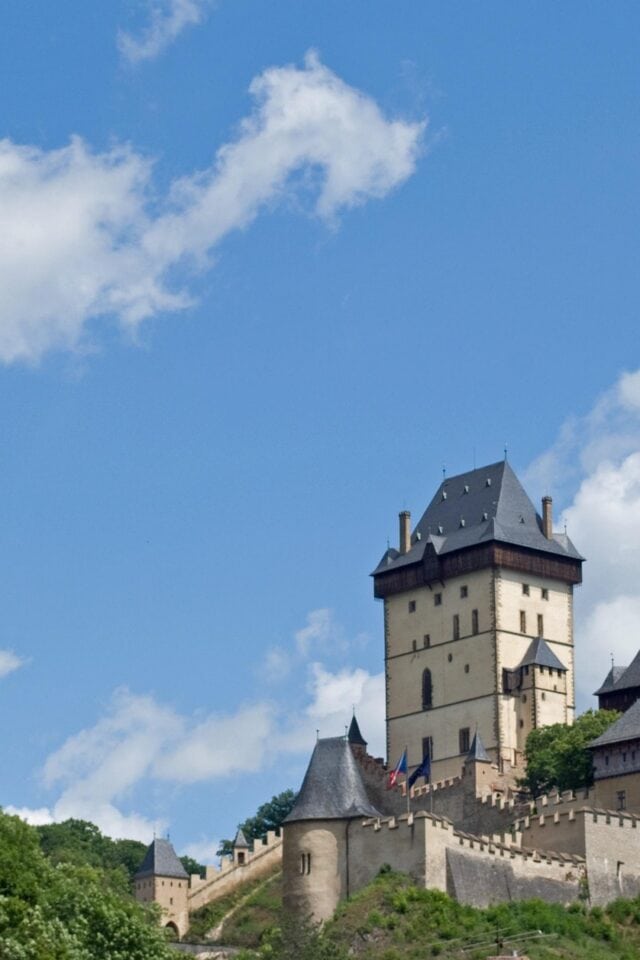
Emperor Charles IV built Karlštejn in 1348 on a limestone ridge above the Berounka valley, 30 kilometres southwest of Prague, to house the imperial crown jewels and holy relics. The castle climbs the rock in three vertical tiers, with the Chapel of the Holy Cross at its summit entirely encased in semi-precious stones and gold leaf. Visiting requires a timed guided tour, which takes groups through progressively cooler chambers as you ascend into the keep. The upper rooms, rarely touched by direct sunlight, maintain a stable temperature regardless of what is happening outside. The valley below the castle is wooded and the approach on foot from the village takes visitors through riverside forest. A practical bonus: because Karlštejn is one of the most visited castles in Bohemia, timed entry keeps crowds manageable.
Website: hradkarlstejn.cz
6. Château de Bouillon — Ardennes, Belgium
The most dramatically positioned castle in Belgium sits on a narrow tongue of rock encircled on three sides by the River Semois in the deep forested Ardennes. Bouillon was the stronghold of Godfrey of Bouillon, who sold it to fund the First Crusade in 1095. The river bend creates a microclimate that is measurably cooler than the surrounding plateau, and the Ardennes forest above the valley adds to the effect. The castle itself is largely open-air — a sequence of towers, baileys, and cliff-edge terraces — making it ideal summer exploration without the enclosed stuffiness of more fully restored interiors. The views over the Semois from the upper tower are outstanding. The gardens along the riverbank below the castle are public and provide shade throughout the day.
Website: bouillon-initiative.be
7. Książ Castle — Lower Silesia, Poland
The third largest castle in Poland, Książ rises from a forested ridge above the Pełcznica river valley near Wałbrzych, and it has one of the most extraordinary subterranean histories in Europe. During the Second World War, the occupying German administration excavated a vast network of tunnels beneath the castle — part of the Nazi Project Riese — and these tunnels are open to visitors today. Underground temperatures remain at a constant 8 to 10 degrees Celsius year round. Above ground, the castle’s Baroque state rooms and terraced gardens, redesigned at the turn of the 20th century for Princess Daisy of Pless, are remarkable in their own right. The rose terrace — one of the finest in Poland — is best seen in June and July. The forest park surrounding the ridge is old and dense, making the approach through the valley one of the cooler summer walks in the region.
Website: ksiaz.walbrzych.pl
8. Château de Pierrefonds — Picardy, France
Most visitors to northern France head to the Loire Valley. Fewer make it to the Oise department, where Pierrefonds stands above a lake-edged village in the Forest of Compiègne. The forest is enormous — 14,000 hectares of mature beech and oak — and acts as a heat buffer for the entire area. Pierrefonds itself is a 19th-century restoration by Eugène Viollet-le-Duc, commissioned by Napoleon III, and represents his most complete and ambitious work: a medieval fortress rebuilt as it was imagined to have been, rather than as it actually was. The result is spectacular regardless of your views on historical authenticity, and the castle’s vaulted halls and internal courtyards are consistently cool. The lake at the foot of the hill is surrounded by public parkland. Between Pierrefonds and the broader Compiègne estate, this is one of the most undervisited royal landscapes in France.
Website: pierrefonds.monuments-nationaux.fr
9. Hohenschwangau Castle — Bavaria, Germany
While its more famous neighbour Neuschwanstein draws the larger crowds, Hohenschwangau, the childhood home of King Ludwig II, offers a more intimate experience. Situated lower on the hillside and surrounded by alpine forest, the castle benefits from elevation and shade that Neuschwanstein, does not always provide. The Alpsee lake directly below the castle is swimmable in summer and ringed by walking paths under old trees. Interiors are furnished as they were in Ludwig’s day, with original wallpapers and furniture largely intact, giving a domestic warmth that contrasts sharply with Neuschwanstein’s theatrical ambition. The gardens between the two castles follow the hillside and are at their best in July, with alpine meadow flowers and mountain views.
Website: hohenschwangau.de
10. Kliczków and Czocha — Lower Silesia, Poland
Western Lower Silesia, where Poland meets Germany and the Czech Republic, contains two medieval castles within 30 kilometres of each other that make a natural summer pairing. Both sit directly on water. Both are almost entirely unknown outside Poland.
Kliczków stands above the Kwisa river in dense forest, a late medieval castle rebuilt in the Baroque period and restored in the early 20th century. The river wraps around the base of the hill and the surrounding parkland, planted with old-growth trees, keeps the castle in almost continuous shade. The interiors are furnished and open to visitors; the grounds include riverside walks along the Kwisa that stay cool even in August.
Czocha, 25 kilometres to the south, takes a different approach to water: it sits on a granite outcrop above Lake Leśnia, surrounded on three sides by the reservoir. The lake generates its own breeze and the castle’s terraces face directly over the water. Czocha dates from the 13th century and was rebuilt in the early 20th century, with interiors that include a knights’ hall, a dungeon, and a weapons collection. It now operates partly as a hotel and cultural centre.
Together they make one of the most rewarding castle day-trips in Poland, through a landscape of forest, river, and lake that feels entirely removed from the heat of the surrounding plains.
Kliczków: zamek-kliczkow.pl Czocha: zamek-czocha.pl